America’s Military Spending Grew 71x Since 1949, and the Machine Behind It Never Stopped
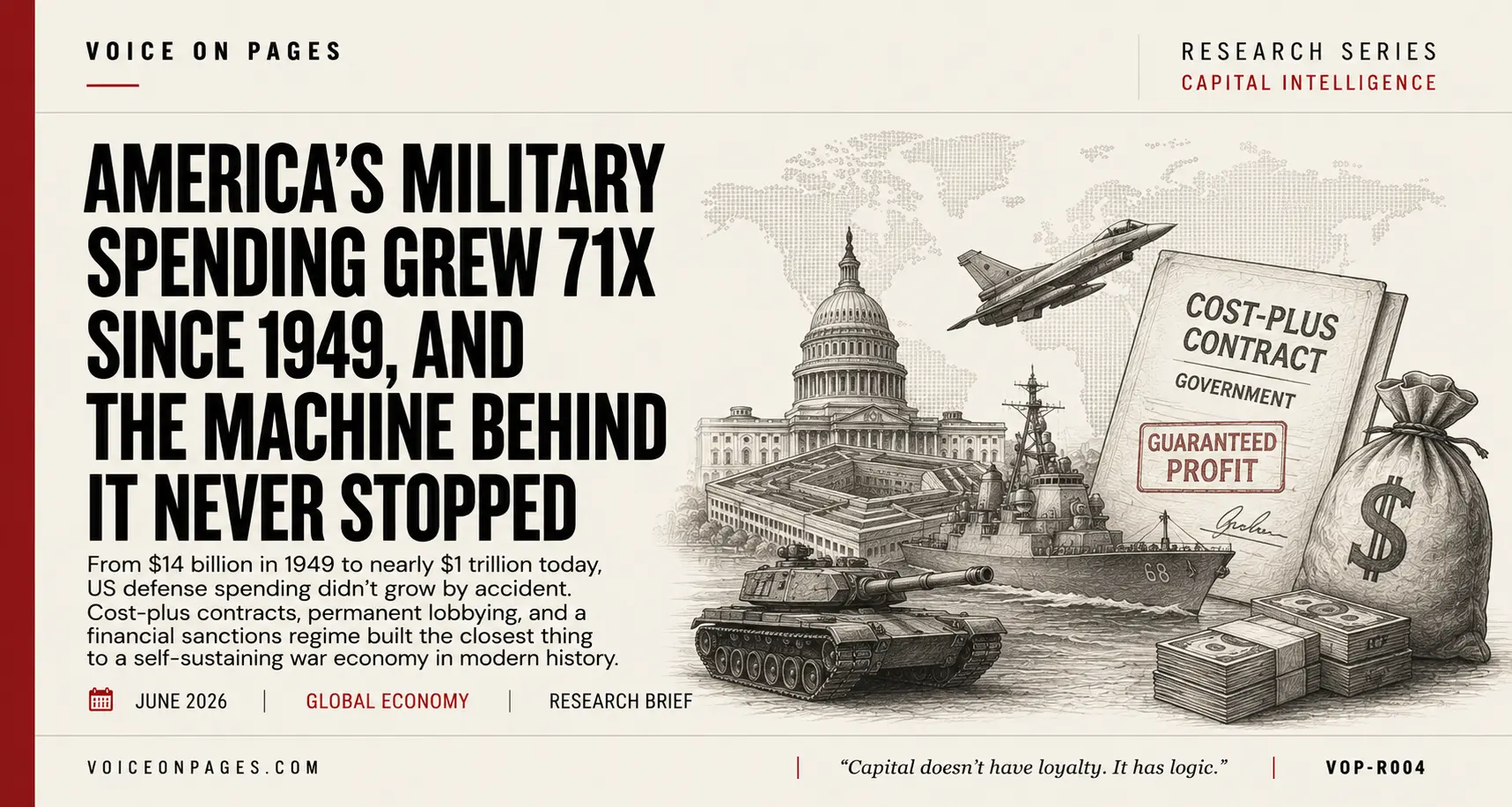
Quick Answer: US military spending rose from about $14 billion in 1949 to roughly $997 billion in 2024, a 71-fold increase, and the US now accounts for 37% of everything the world spends on its militaries combined. That growth wasn’t driven by a single war. It was built into the financial structure of the defense industry itself, starting with WWII contracts that removed all financial risk from arms production, and it hasn’t meaningfully reversed since.
Near-Continuous War Since 1945
Since the end of World War II, the US has conducted well over 100 named military operations: Korea (1950-1953), Vietnam (1955-1975, with large-scale combat from 1965-1973), the Gulf War (1990-1991), Bosnia and Kosovo (1995-1999), Afghanistan (2001-2021), and Iraq (2003-2011, with follow-on operations continuing after). Laid end to end, there is almost no multi-year stretch since 1945 without an active US military engagement somewhere in the world.
That pattern is the setup for the real question: is this foreign policy responding to threats as they emerge, or is it something closer to a permanent economic system that requires ongoing justification?
The Spending Trajectory
The scale of growth is the clearest evidence something structural is happening. US military spending sat at roughly $14 billion in 1949, a record low in the modern series. By 2024, that figure had reached approximately $997 billion, a roughly 71-fold increase. As a share of GDP, US defense spending in 2024 sat at about 3.4%. As a share of total federal spending, defense has typically run 10-15% in recent years, and exceeded 20% during peak Cold War years.
Globally, the US alone accounts for 37% of all military spending on Earth, more than the next several countries combined, and roughly 66% of total NATO military spending. Even after the Cold War ended and the “peace dividend” was supposed to arrive, US military spending never fell below about 3% of GDP, a baseline still well above the roughly 2% target most other NATO members operate near.
The Origin: Cost-Plus Contracts and WWII
The structural template for all of this was set during World War II, not the Cold War. As the US mobilized for war after 1940, the government used cost-plus contracts: it reimbursed defense contractors for all production costs and guaranteed them a profit margin on top. This removed nearly all financial downside risk from wartime production. Firms were rewarded for scale and volume of output, not efficiency. Boeing, Lockheed, General Motors, Ford, and General Electric all ramped into mass aircraft, vehicle, and munitions production under this model, and all of them remained core defense suppliers long after the war ended. The contract structure that won WWII became the business model that outlived it.
Eisenhower’s Warning, and What Followed
In his 1961 farewell address, President Eisenhower coined the term “military-industrial complex,” describing the combination of a permanent armaments industry and a large standing defense establishment, and warning explicitly against its “unwarranted influence” and the “disastrous rise of misplaced power.” What followed in the decades after looks like a direct confirmation of that warning, expressed in lobbying dollars rather than just institutional structure.
By 2024, the defense sector spent roughly $149.4 million lobbying Washington, working with 385 clients through about 950 lobbyists, nearly 62% of whom were former government officials moving through what’s often called the revolving door. Broken down by subsector, Misc Defense accounted for about $74.3 million of that spending, Defense Aerospace about $58 million, and Defense Electronics about $17.1 million. The scale of the underlying industry is significant too: the top 100 aerospace and defense companies collectively generated approximately $729 billion in revenue and $81 billion in operating profit in 2018 alone.
The Post-9/11 Bill
Nowhere is the financial scale clearer than in the accounting of the wars launched after September 11, 2001. By fiscal year 2020, the US had appropriated and obligated approximately $6.4 trillion for the wars in Afghanistan, Iraq, Syria, and related operations, according to Brown University’s Costs of War project. Once veterans’ care and interest on the debt used to finance the wars are included, updated estimates put the total above $8 trillion through roughly fiscal year 2022. An earlier 2017 estimate from the same research put the per-taxpayer cost at approximately $23,000. Separately, the same research estimates roughly 929,000 people, combatants and civilians combined, were killed directly in post-9/11 conflict zones. Much of this spending was financed through borrowing rather than taxation, meaning the cost compounds through interest for decades beyond the wars themselves.
Looking ahead, the Congressional Budget Office projects the US will spend approximately $817 billion on nuclear forces between 2025 and 2034, with the majority of that total, several hundred billion dollars, earmarked specifically for modernizing missiles, submarines, and bombers rather than operations and maintenance. That’s a locked-in future cost, not a response to any current conflict.
The Newer Front: Financial Warfare
Alongside conventional military spending, the same system has built a second, less visible arm: sanctions and control of the dollar-based financial system itself. SWIFT, the global messaging network that underpins most international bank payments, has become a tool of coercion in its own right. Iran has faced sanctions targeting its banking access and oil exports for decades, including the disconnection of numerous Iranian banks from SWIFT in 2012 under joint EU and US pressure. Russia faced a far larger version of the same tool in February 2022, when the US and allies blocked assets of Russia’s central bank held in the US and cut major banks, including Sberbank and VTB, off from SWIFT and dollar clearing. Early assessments projected the sanctions would contribute to roughly a 15% medium-term contraction in Russia’s GDP and push inflation into double digits, with the ruble losing about 30% of its value in the initial shock.
This is warfare conducted through the architecture of the dollar system rather than through deployed troops, and it depends on the same US financial dominance that underwrites the conventional military budget.
The Bottom Line
The throughline across 80 years isn’t any single war or any single president’s policy. It’s a financial structure, built during WWII, reinforced through the Cold War, and never meaningfully dismantled, in which permanent high defense spending, a lobbying apparatus that helps sustain it, and now financial sanctions as an added lever, all reinforce each other. Whether that system could realistically pivot toward peace isn’t really a policy question at that point. It’s a question of what happens to an economy, and a political class, built around it for eight decades.
Sources: SIPRI Military Expenditure Database, Watson Institute Costs of War project (Brown University), OpenSecrets, Congressional Budget Office, Eisenhower Foundation, US Department of the Treasury, and World Bank, 2026.