Private Credit’s First Real Liquidity Test: What Blue Owl’s Redemption Freeze Reveals About a $4.1 Trillion Market
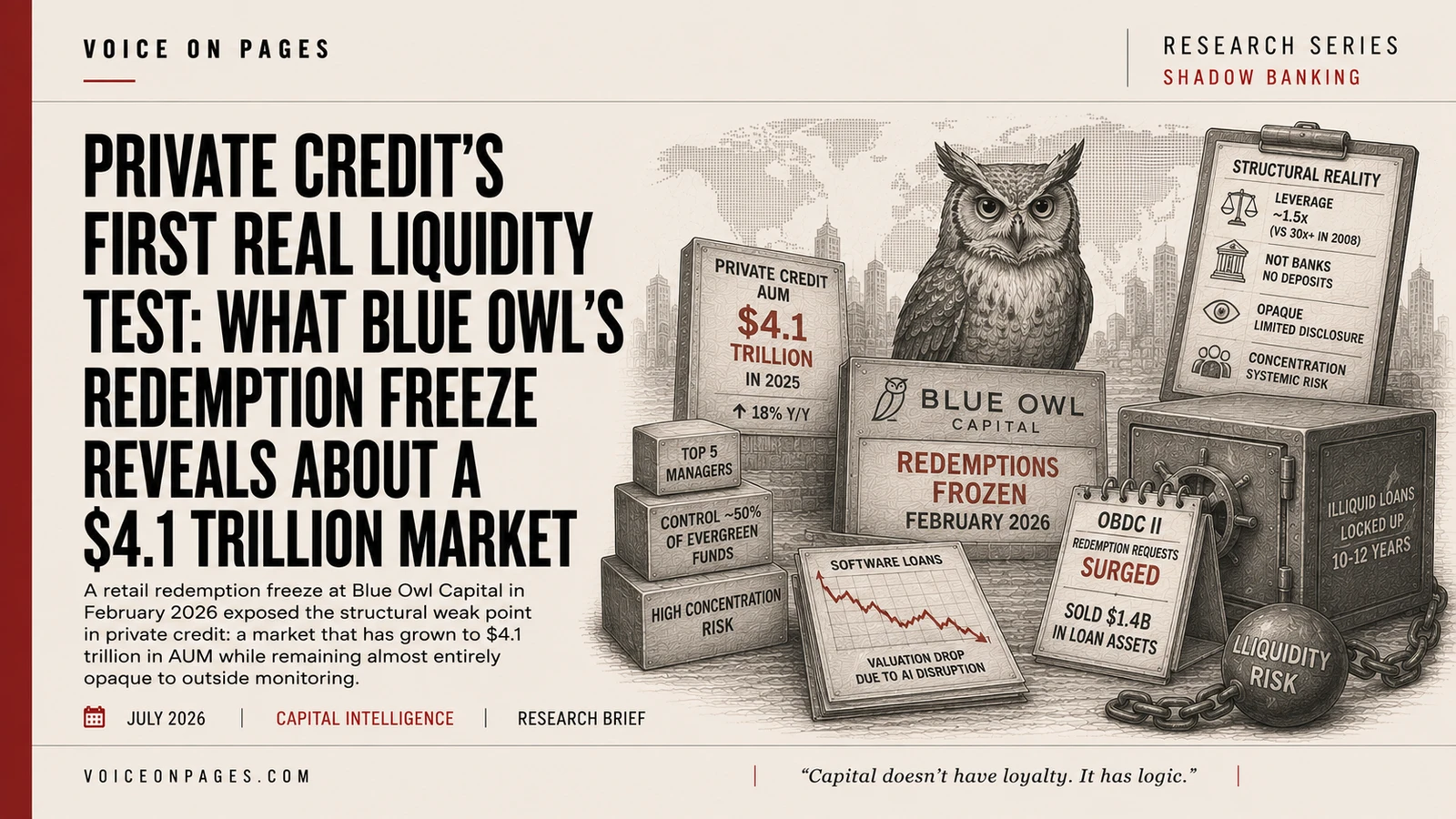
Private credit assets under management reached $4.1 trillion in 2025, and the sector’s first real liquidity stress test came in February 2026, when Blue Owl Capital froze redemptions on a retail debt fund after AI-driven software loan losses triggered elevated withdrawal requests.
What Actually Happened
On February 18, 2026, Blue Owl Capital ended quarterly redemptions on Blue Owl Capital Corporation II (OBDC II), a retail-facing, non-traded business development company. Instead of the usual 5% quarterly tender offer, the fund would return capital through periodic distributions funded by asset sales, loan repayments, and earnings, meaning investors could no longer request withdrawals on demand. Alongside the announcement, Blue Owl sold $1.4 billion in direct lending assets across three funds — OBDC II, OBDC, and Blue Owl Technology Income — to four institutional pension and insurance buyers.
The market reaction was immediate. Blue Owl shares fell roughly 6% to 9% depending on the trading session, and the sell-off spread to peers: Apollo Global and Blackstone fell more than 5%, Ares and KKR fell 2% to 3%, and in a related sell-off earlier that month tied to the same underlying AI-disruption concern, Ares fell over 12% and Blue Owl lost more than 8% in a single week.
This was not an isolated event. It was the first time non-listed BDCs recorded net quarterly outflows on record, according to industry monitors, and it landed directly on top of a global private credit market that had just crossed $4.1 trillion in AUM, up 18% from the year before.
The Scale Nobody Outside the Funds Can Fully See
Private credit’s growth over the past five years has been extraordinary by any measure. Private and non-traded BDC portfolio value rose from $21.5 billion in 2020 to roughly $394 billion by late 2025. Evergreen private credit funds, which offer periodic liquidity, hit a record $644 billion in AUM as of mid-2025, up 45% year over year. Average direct lending buyout sizing nearly doubled from $200 million in 2020 to $380 million in 2025, and mega-loans above $1 billion, once rare, totaled more than $58 billion in the first three quarters of 2025 alone, compared with just $6 billion five years earlier.
The top five managers in the fast-growing evergreen segment — Blackstone, Blue Owl, Ares, Sixth Street, and Cliffwater — control nearly half of that market’s global AUM. This concentration matters because private credit operates almost entirely outside public disclosure requirements. Fund-level AUM, top-line sector exposure, and headline leverage ratios are reported to regulators and, for listed BDCs, in public filings. But the underlying loan agreements, borrower-level financial metrics, precise covenant terms, and valuation model assumptions are not publicly disclosed anywhere. The Financial Stability Board’s May 2026 report on private credit vulnerabilities flagged exactly this: data gaps and inconsistent definitions across jurisdictions make it difficult for regulators themselves to assess exposures and how stress might transmit through the system.
Why the Loans Ended Up Here in the First Place
Private credit’s rise is a direct consequence of post-2008 bank regulation, not a coincidence of market timing. Basel III capital rules and the 2013 US Interagency Guidance on Leveraged Lending made it capital-punitive for regulated banks to hold loans to companies with leverage above 6x debt-to-EBITDA or negative earnings. Banks retreated from exactly the kind of mid-market, higher-risk corporate lending that private credit funds were structurally free to do instead, since they answer to fund investors rather than banking regulators.
That regulatory gap is now narrowing. In December 2025, the OCC and FDIC formally rescinded the 2013 leveraged lending guidance, and a re-proposed Basel III Endgame framework released in March 2026 raised the asset threshold for the strictest capital rules from $100 billion to $700 billion, freeing most regional and large regional banks from the toughest requirements. Analysts estimate this could unlock roughly $1.26 trillion in additional bank balance sheet lending capacity, setting up direct competition between banks and private credit funds for large-cap corporate refinancing through 2026 and 2027 for the first time since the asset class’s founding.
The AI Shock That Hit Software Loans Specifically
Software is the single largest sector exposure in private credit portfolios, and this is where the Blue Owl stress event actually originated. Estimates of software’s share of BDC portfolios range widely by manager and methodology, from roughly 13% at S&P Global’s broadest credit estimates to over 20% to 27% at BDCs managed by Golub Capital, Ares, and Blackstone specifically. Research from the Bank for International Settlements found SaaS loans grew from under $8 billion in 2015 to over $500 billion, or 19% of total direct loans, by the end of 2025.
In January and February 2026, the commercial rollout of advanced agentic AI tools, including Anthropic’s Claude Code, triggered a broad software sector sell-off on fears that generative AI would disrupt per-seat software licensing models. Software company stocks fell nearly 30% between October 2025 and February 2026. Loan prices for the software and IT sector in the S&P UBS Leveraged Loan Index fell 465 basis points in a single month, and UBS credit analysts warned that private credit default rates could climb as high as 13% in an aggressive AI-disruption scenario, compared with roughly 8% for public leveraged loans and 4% for high-yield bonds. BDCs with high software exposure underperformed lower-exposure peers by roughly 5 percentage points over the same period.
Not every analyst agrees the panic is proportionate to the actual risk. Some point out that private credit’s yields were always priced to compensate for exactly this kind of borrower-specific risk, and that the difference between a well-underwritten loan to a profitable enterprise software firm and a leveraged buyout loan to a mid-market SaaS company running on payment-in-kind interest is significant and often lost in broad-brush coverage of the sector.
The 2008 Comparison, and Where It Actually Breaks Down
The instinct to call this “shadow banking 2008 again” is understandable given the parallel growth of an unregulated, bank-adjacent lending sector — but the structural comparison does not hold up on the specifics.
The 2008 crisis was built on short-term repo and commercial paper funding leveraged vehicles at 30x debt-to-equity or more, financing residential mortgages to overextended consumers, wrapped in opaque, correlated CDO structures, with losses landing on deposit-taking banks that were themselves systemically critical to the payments system. Private credit today is structurally different on nearly every one of those points. Roughly 78% of surveyed private credit managers use leverage below 1.5x. Capital comes from long-duration, closed-end institutional LP commitments locked up for 10 to 12 years, not overnight funding vulnerable to a run. Loans are direct, bilateral, first-lien claims on corporate assets and cash flows rather than securitized and re-securitized mortgage tranches. And losses, when they occur, are absorbed by sophisticated institutional limited partners like pension funds and insurers who can hold illiquid positions to maturity, rather than by systemically critical retail banks.
The FSB’s own May 2026 assessment reflects this distinction. It does not characterize private credit as an imminent systemic risk. It says the sector remains untested in a prolonged, severe downturn, and flags growing interconnections with banks — chiefly through the synthetic risk transfer market, where banks offload credit risk on loan portfolios to private credit funds in exchange for a premium, in order to free up their own regulatory capital — as the channel worth watching closely.
India’s Position: Insulated on Structure, Exposed on Capital Flows
India’s private credit market grew 35% in 2025 to $12.4 billion across 166 transactions, up from $9.2 billion in 2024, according to EY’s H2 2025 report. The largest deal of the cycle was the Shapoorji Pallonji Group’s refinancing, anchored by domestic wealth platforms including InCred Capital, DSP Finance, and IIFL Capital alongside global managers like Farallon Capital and Davidson Kempner, who funded an offshore dollar tranche routed through a Mauritius special purpose vehicle.
Structurally, India’s market looks nothing like the US and European private credit ecosystem, and that is by regulatory design rather than accident. SEBI prohibits Category I and II Alternative Investment Funds, the vehicles through which most Indian private credit operates, from taking on long-term fund-level leverage. There are no retail-accessible evergreen funds or BDC-equivalent vehicles offering periodic redemptions in the Indian market, and access is restricted to sophisticated, high-net-worth and institutional investors. The RBI separately ring-fences commercial bank exposure to AIFs, cutting off the bank-fund interlinkage channel that Western regulators are most worried about. Private credit in India accounts for roughly 0.6% of GDP and barely 1% of total bank credit, roughly a tenth of the relative penetration seen in the United States.
That does not mean India is immune to a Western private credit downturn, only that the transmission mechanism is different. Global alternative funds account for roughly 55% of total private credit capital inflows into India, so a US retail redemption wave or capital-preservation pullback would slow offshore funding for leveraged Indian conglomerates. Indian firms relying on offshore dollar placements, like the Shapoorji Pallonji Mauritius SPV structure, would face wider credit spreads and higher refinancing costs in a global risk-off environment. And a broader risk-off cycle triggered by a Western private credit event would likely hit Indian public equities and government debt through the same FII channel that has driven volatility in Indian markets before, pressuring the rupee and raising currency hedging costs in the process.
Quick Answers to Common Questions
Is private credit heading for a 2008-style financial crisis? The structural comparison does not hold. Private credit funds use roughly 1.5x leverage on average versus the 30x-plus leverage in 2008-era mortgage vehicles, and capital is locked up for 10 to 12 years rather than funded through overnight repo markets, which removes the run-on-the-bank dynamic that drove the 2008 crisis. The real risk regulators are flagging is opacity and concentration, not imminent systemic collapse.
Why did Blue Owl restrict investor redemptions in 2026? Blue Owl Capital saw rising redemption requests on its retail-facing fund OBDC II through 2025 and into early 2026, partly linked to software-loan exposure hit by AI disruption fears. In February 2026 the firm ended its quarterly tender-offer structure, sold $1.4 billion in loan assets across three funds, and switched to periodic return-of-capital distributions instead of on-demand redemptions.
How exposed is India to a private credit downturn in the US or Europe? India’s domestic private credit market is structurally insulated because SEBI prohibits fund-level leverage for Category II Alternative Investment Funds and the RBI limits bank exposure to these funds. Exposure to a Western unwind would come through foreign portfolio investor capital withdrawal, tighter offshore dollar refinancing for large Indian conglomerates, and broader FII selloffs in Indian equities during a global risk-off move, not through direct banking linkages.
How big is the global private credit market in 2026? Dedicated private credit strategy AUM reached approximately $4.1 trillion in 2025, an 18% increase over the prior year, according to McKinsey’s Global Private Markets Report. The narrower direct lending segment alone is estimated between $1.7 trillion and $2.2 trillion by the Financial Stability Board.
The Bottom Line
Private credit did not have a 2008 moment in early 2026. It had a concentration-and-opacity moment: a handful of firms hold outsized exposure to a single sector under stress, retail investors who bought yield without fully pricing the illiquidity discovered the redemption terms were softer than they assumed, and regulators admitted they still can’t see far enough inside the loan books to know how deep the exposure actually runs. That is a narrower, more precise risk than a subprime rerun, and arguably a more durable one, because it doesn’t require a severe recession to materialize. It just requires the next sector under AI-driven pressure, or the next $12.7 billion wall of BDC debt maturing in 2026, to land on a market still running largely on trust rather than disclosure.
Sources: Financial Stability Board, CNBC, EY India, Bank for International Settlements, McKinsey & Company, verified via direct web search, July 2026.