Chile, Guatemala, and the Central Banks Buying Gold for a Very Different Reason Than China
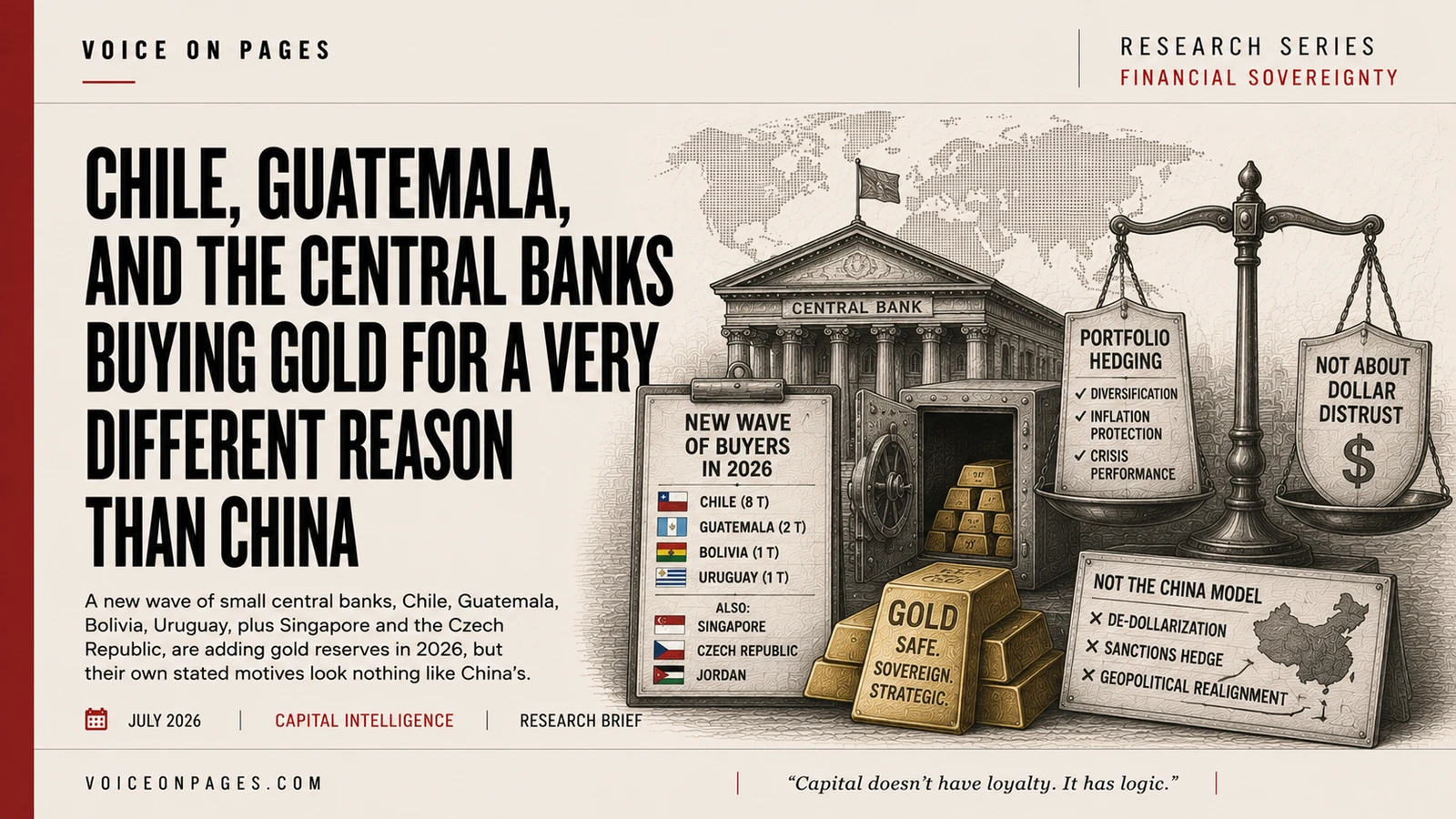
A new wave of small central banks, including Chile, Guatemala, Bolivia, and Uruguay in Latin America plus Singapore, the Czech Republic, and Jordan elsewhere, are adding gold reserves in 2026, but their own stated motives are classic portfolio hedging and inflation protection, not the dollar-distrust and sanctions-proofing logic driving China and Russia’s much larger purchases.
What Actually Happened
The World Gold Council published its Ninth Central Bank Gold Reserves Survey on June 16, 2026, conducted with YouGov between February 5 and May 19, drawing responses from 76 central banks, 18 advanced economies and 58 emerging market and developing economies. The headline findings: 89% of respondents expect global central bank gold reserves to rise over the next 12 months, and a record 45% expect their own institution’s holdings to increase, up from prior years, with only 1% anticipating a decline.
The widely quoted “41 tonnes purchased in May” figure comes from separate WGC monthly statistics, and it is global net buying, not a Latin America-specific number. Gross purchases of roughly 50 tonnes were offset by 9 tonnes of sales, per WGC APAC research lead Marissa Salim. May’s buying was led by Poland (18 tonnes), China (10 tonnes), Uzbekistan (9 tonnes), Kazakhstan (7 tonnes), and Singapore re-entering the market with 4 tonnes, its first net purchase since September 2025. Russia and Turkey were net sellers, offloading 6 and 3 tonnes respectively that month.
The Actual Latin American Buyers
Four Latin American central banks show real, documented gold accumulation through May 2026: Chile (about 8 tonnes), Guatemala (2 tonnes), Bolivia (1 tonne), and Uruguay (1 tonne), a combined 12 tonnes. Brazil, Mexico, Peru, Colombia, Argentina, and Paraguay show no comparable structural change, keeping reserves concentrated in US Treasuries, sovereign debt, and foreign currency deposits.
Chile’s move is the most significant on its own terms, even if small in absolute tonnage. Chilean sources confirm the central bank’s gold reserve line jumped from $42 million in January 2026 to $1.108 billion in February, the first significant gold purchase by Banco Central de Chile since 1997, when it began winding down its prior gold position, finishing the sale by 2000. By March, Chile’s gold reserves had grown further to roughly $1.4 billion, then continued climbing through Q2. As of the WGC’s cited YTD figures through May, this puts Chile’s gold at roughly 2% of its approximately $51 billion in total international reserves, up from essentially zero at the start of the year.
The Scale Check: This Is Not China
Twelve tonnes across four countries over five months doesn’t move markets. Poland alone added 64 tonnes over the same window, more than five times the entire Latin American cohort combined, pushing its total holdings to 614 tonnes against a public 700-tonne target. China added 25 tonnes year-to-date, bringing its official reserves to 2,331 tonnes, still only about 9% of its total reserves. Uzbekistan (33 tonnes YTD) and Kazakhstan (20 tonnes YTD) hold gold at 87% and 78% of their respective total foreign exchange reserves, an entirely different order of structural commitment than Chile’s roughly 2%.
| Country | 2026 YTD Purchases | Total Gold Holdings | Gold Share of Reserves |
|---|---|---|---|
| Poland | 64 tonnes | 614 tonnes | ~15.5% (targeting 700t) |
| Uzbekistan | 33 tonnes | ~380 tonnes | 87% |
| China | 25 tonnes | 2,331 tonnes | 9% |
| Kazakhstan | 20 tonnes | 361 tonnes | 78% |
| Singapore | 4 tonnes | 197 tonnes | ~5% |
| Chile | ~8 tonnes | ~8 tonnes (monetary gold) | ~2% |
| Guatemala | 2 tonnes | ~9 tonnes | ~3.2% |
| Bolivia | 1 tonne | ~23 tonnes | ~12.5% |
| Uruguay | 1 tonne | ~1 tonne | <1% |
Why the “Dollar Distrust” Framing Doesn’t Hold Up
This is the central finding worth correcting before it spreads further: the WGC’s own survey data separates two genuinely different tiers of buyer, and Latin America sits firmly in the tier that isn’t about the dollar.
Asked directly why they hold gold, central banks ranked crisis performance highest at 90% (a survey-history record, and higher among EMDE respondents at 92% than advanced economies at 81%), followed by long-term store of value at 84% and portfolio diversification at 83%. Geopolitical risk hedging showed the sharpest divergence: 85% of EMDE central banks called it relevant versus only 56% of advanced economies, but that’s still a risk-hedging rationale, not an explicitly anti-dollar one.
Chile’s own central bank has been direct about this in its public statements. It described the purchase as the result of periodic technical review finding “changes in correlations between eligible assets,” concluding that adding “a limited portion of gold contributes to improving portfolio risk diversification,” language that describes routine reserve management, not currency-system defection. Chile’s reserves remain anchored in US Treasuries (64% of its sovereign bond holdings) alongside Germany, Canada, and Australia.
Contrast that with China, whose 20 consecutive months of gold accumulation trace explicitly to de-dollarization and sanctions-proofing following the 2022 G7 freeze of roughly $300 billion in Russian reserves, a motive Latin American central banks have not cited for their own purchases.
| China / Russia tier | Chile / Guatemala tier | |
|---|---|---|
| Primary motivation | Sanctions-proofing, freeze-risk mitigation | Portfolio diversification, inflation hedge |
| Target gold share | Structural, ongoing increase | Marginal rebalancing (1-5%) |
| USD stance | Active reduction of USD clearing reliance | Maintains majority USD sovereign holdings |
The World Gold Council’s Own Correction to the “Latin America” Story
The WGC’s own analysis explicitly warns against the framing this article was originally pitched around. Commentators narrowing this trend to a Latin American narrative are, in the Council’s own characterization, misreading a synchronized, multi-regional diversification drive. The same pattern is showing up in Southeast Asia (Singapore re-entering the market and building domestic vaulting infrastructure for October 2026), Central Europe (the Czech National Bank now on a 39-consecutive-month buying streak), and the Middle East (Jordan adding to reserves). Latin America is one region among several doing the same thing at roughly the same modest scale, not a standalone story.
The IMF’s Counter-Warning
The IMF’s July 2026 policy note (No. 2026/007), authored by Istvan Mak and Etienne Vaccaro-Grange, pushes back on the broader gold-buying enthusiasm directly. Its central warning: a meaningful share of gold’s rising share in global reserves reflects valuation gains from higher prices, not new physical accumulation, and reserve managers risk mistaking that price appreciation for a durable improvement in reserve adequacy.
The timing gives the warning teeth. Gold fell from a record intraday peak near $5,589 an ounce on January 28, 2026, to roughly $4,046 by July, a correction of about 28%, the steepest quarterly drop since 2013. The IMF’s other technical objections: gold produces no yield in a higher-for-longer rate environment; it is poorly suited to a central bank’s liquidity tranche because converting large holdings to cash during a crisis carries market-impact costs and settlement lag; and domestic gold-purchase programs (relevant to Bolivia, which sources part of its reserves from domestic mining) raise governance, anti-money-laundering, and monetary-policy conflicts serious enough that the IMF recommends moving that function off central bank balance sheets entirely.
Reconciling With the Broader 2022-2026 Picture
Global central bank net gold buying exceeded 1,000 tonnes annually from 2022 through 2023 (1,082 and 1,037 tonnes respectively), roughly double the 2012-2021 decade average near 500 tonnes a year. 2026 is running below that record pace despite continued strong buying: Q1 came in at 244 tonnes and Q2 rebounded to 289 tonnes, for a first-half total of 533 tonnes. Gold’s share of global reserves briefly surpassed aggregate sovereign US Treasury holdings in early 2026 at gold’s price peak, per European Central Bank commentary, before the subsequent 28% correction pulled that mark-to-market share back down, exactly the dynamic the IMF’s note warns about.
The Skeptic View
Critics of the “second wave” framing make three points worth carrying forward honestly. First, scale: 12 tonnes across four countries over five months averages under 2.5 tonnes a month continent-wide, treating Chile’s 8-tonne addition as a systemic realignment overstates a routine rebalancing. Second, some of what gets reported as central bank “buying” in smaller economies reflects absorption of domestic mining output rather than open-market purchases, a distinction the IMF’s note flags directly regarding Bolivia’s sourcing. Third, macro headwinds: the same 28% price correction that validated the IMF’s valuation warning also demonstrates gold’s real vulnerability if elevated real rates persist, which could cool price-sensitive buying among exactly this tier of smaller reserve managers going forward.
The Bottom Line
The real story isn’t that small emerging-market central banks are quietly defecting from the dollar. It’s that gold has become mainstream, boring reserve-management practice across a wide, unglamorous tier of mid-sized institutions, for reasons that look nothing like China’s. Chile buying gold for the first time since 1997 is a genuinely notable data point. It is not evidence of the same phenomenon driving Beijing’s 20-month buying streak, and treating the two as one story flattens a real distinction the data itself draws clearly. Because in the end, capital doesn’t have loyalty. It has logic, and for most of these smaller buyers, that logic is closer to an insurance premium than a political statement.
Sources: World Gold Council, IMF eLibrary, Kitco News, OMFIF, Banco Central de Chile reporting via Ex-Ante and La Tercera, verified via Google Deep Research and live web search, July 2026.