China’s 2026 Central Bank Law Revision: How Beijing Is Building a Legal Shield Against U.S. Sanctions
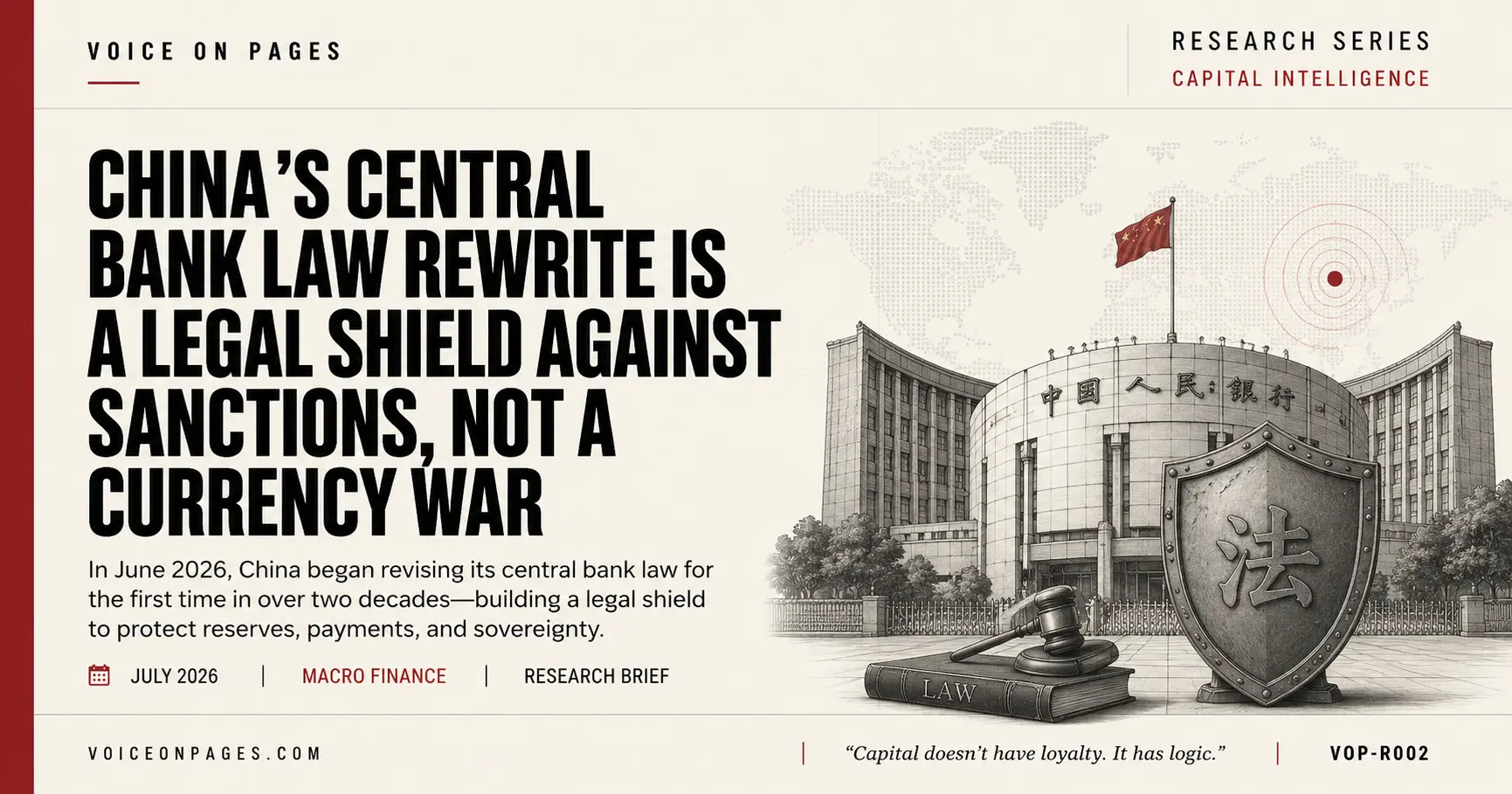
In June 2026, China’s top legislature began the first revision of its central bank law in over two decades, and buried inside the technical language is a deliberate legal shield against foreign sanctions, built alongside new rules that let Beijing blacklist foreign companies for enforcing those sanctions on Chinese soil.
What Actually Happened
At the June 2026 Lujiazui Forum in Shanghai, Vice Premier He Lifeng told the audience that China would embed anti-sanctions provisions directly into its financial legislation and expand what he called a “financial legal toolbox” to counter “improper unilateral sanctions.” Days later, the National People’s Congress Standing Committee held the first reading of a draft revision to the Law on the People’s Bank of China, an eight-chapter, 54-article document aimed at strengthening macro-prudential authority and drawing a firm line against systemic financial risk.
Two details separate this draft from a routine regulatory update. First, it explicitly recognizes the digital yuan as legal currency, placing it on equal legal footing with physical renminbi, and gives the PBOC enforcement power against private digital tokens designed to substitute for it, including confiscation and fines of up to five times the illegal amount. Second, Caixin’s reporting on the draft ties it directly to a broader anti-sanctions legal architecture that China has been assembling since 2021.
That architecture is not new. What changed in 2026 is that Beijing moved these mechanisms out of ministerial-level rules and into core national law, where they carry more weight and are harder to ignore.
The Legal Buildup: From Russia’s Frozen Reserves to Beijing’s Toolkit
The clearest trigger for this shift happened four years before it. In February and March 2022, the G7 and EU froze roughly USD 300 billion of Russia’s foreign exchange reserves, about half of what Russia held, in response to the invasion of Ukraine. Russia’s own finance minister confirmed the number publicly. For Chinese policymakers, who hold a significant share of their reserves in dollar and euro assets, the episode was proof that reserve safety depends on politics, not creditworthiness.
The timeline since then shows a country building toward this moment rather than reacting to a single event:
- 2015: The PBOC launches CIPS, the Cross-Border Interbank Payment System, an RMB-denominated alternative settlement channel that still relies partly on SWIFT messaging but reduces total dependence on it.
- 2021: China adopts the Anti-Foreign Sanctions Law (AFSL), giving Beijing a statutory basis to freeze assets, ban entry, and prohibit transactions against parties that implement foreign sanctions against Chinese interests.
- 2022: Russia’s reserves are frozen and its banks partially cut from SWIFT, the event that hardens Chinese resolve.
- 2023-2024: Western sanctions on Chinese entities surge. Rhodium Group data shows nearly 1,300 individual Chinese companies carrying Western sanctions-related designations by May 2024, with a record 198 entities blacklisted in a single quarter.
- April 2026: The State Council issues Order 834 on industrial and supply chain security and Order 835 on countering foreign unlawful extraterritorial jurisdiction, creating the Malicious Entity List.
- June 2026: He Lifeng announces anti-sanctions clauses will be written into financial law, and the PBOC law revision gets its first legislative reading.
Each step closes a gap the previous one left open. The AFSL gave China a legal basis to retaliate. The 2026 orders elevated that basis from departmental rule to State Council-level regulation. The PBOC law revision now gives the central bank itself the operational tools, liquidity facilities, payment infrastructure oversight, and digital currency authority, to act on that basis during an actual crisis.
What the Law Actually Does
Sanctions work because they are legal obligations, not physical barriers. A US sanction has force because it legally binds US persons and, often, any non-US entity that touches the dollar system. China’s 2026 legal package attacks that mechanism directly rather than trying to out-build American financial infrastructure.
Order 835 lets China’s Ministry of Justice formally designate a foreign sanction or court order as “unlawful extraterritorial jurisdiction.” Once designated, no organization or individual inside mainland China is permitted to implement it, and enforcement can extend to entry bans, asset freezes inside China, restrictions on data transfers, exclusion from government procurement, and monetary fines. Crucially, these penalties can reach subsidiaries and entities “actually controlled” by a listed party, meaning a single sanctioned decision made at a foreign headquarters can expose an entire corporate group operating in China.
The PBOC law revision then gives the central bank the operational half of the equation: explicit macro-prudential authority to respond to external shocks, clarified supervision over payment infrastructure including CIPS, and legal certainty over the digital yuan that lets it build payment rails outside Western-controlled systems while staying fully compliant with Chinese law. None of this makes sanctions unenforceable. It raises the legal, political, and operational cost of using them against China.
The Corporate Trap: Why Multinationals Are Caught in the Middle
The practical exposure lands on companies with a footprint in both the US-aligned financial system and China. A firm that halts shipments to a Chinese customer to comply with US export controls can now find its Chinese subsidiary investigated for implementing an unlawful foreign measure, with executives facing entry bans or asset freezes inside China even though the original decision was made to satisfy American law.
This is a genuine conflict of law, not a theoretical one. Legal analysis from firms tracking the regulations notes that “de-risking” supply chain decisions, terminating a Chinese counterparty, refusing certain inputs, blocking a payment, can now be scrutinized on both sides as either required compliance or unlawful discrimination, depending on which government is asking. Because the penalties under Order 835 can attach to individual executives rather than only their companies, sanctions compliance has effectively become a board-level legal exposure question for any multinational with material China operations.
What This Means for the Dollar
None of this collapses dollar dominance overnight, and nothing in the source material supports that claim. The dollar’s role rests on decades of network effects and deep, liquid markets that alternative systems do not yet replicate. What is more likely to erode is sanction credibility: the assumption that a US sanction will function everywhere it is applied. As more of the global economy operates inside legal jurisdictions built specifically to resist that assumption, enforcement becomes harder even where the underlying financial infrastructure has not meaningfully changed.
The practical shift is reserve diversification and settlement migration rather than a dollar exit. Central banks, China’s included, have been steadily increasing gold holdings and expanding non-dollar settlement options since 2022, and the PBOC law revision fits that pattern by giving policymakers more legal room to use tools like CIPS and the digital yuan without contradicting domestic law. The more accurate framing is not that the dollar is being replaced, but that its ability to unilaterally police global finance is being narrowed, one legal article at a time.
Quick Answers to Common Questions
Is China preparing for US sanctions on its sovereign assets? The combination of the AFSL, the 2026 blocking orders, CIPS, and the PBOC law revision reflects a systematic buildup that closely mirrors what Russia’s frozen reserves exposed as a vulnerability, even though Chinese officials rarely name the United States directly.
Can the US legally freeze China’s central bank reserves the way it froze Russia’s? In principle yes, since a significant share of China’s reserves sit in Western-held dollar and euro assets, but the scale of China’s economy would make the disruption far larger and more mutually damaging than the Russia case.
What is the Malicious Entity List? A State Council-level mechanism created under Order 835 that lets China blacklist foreign organizations and individuals for implementing or even promoting sanctions against Chinese interests, with penalties including entry bans, asset freezes, and exclusion from Chinese business dealings.
Does this mean the global financial system is splitting in two? Not cleanly. What is emerging is a more fragmented system with overlapping legal jurisdictions and parallel payment rails, where some flows still run through Western-centric channels and an increasing share run through China-centric or regional alternatives.
The Bottom Line
China spent 2026 converting four years of accumulated anxiety, dating back to Russia’s frozen reserves, into codified law. The PBOC revision is not a headline-grabbing act of defiance; it is the quiet, procedural half of a strategy whose visible half is the Malicious Entity List and the blocking regulations that came two months earlier. Because in the end, capital doesn’t have loyalty. It has logic, and Beijing has just spent a legislative session making sure more of that logic runs through code it controls.
Sources: Xinhua via People’s Daily, Caixin Global, NPC Observer, Bloomberg, CGTN, Reuters, Debevoise & Plimpton, Morrison Foerster, Rhodium Group, Center for a New American Security, verified via Perplexity, July 2026.