US Student Debt Just Passed $1.8 Trillion, But China and India Prove the Trap Doesn’t Need Loans
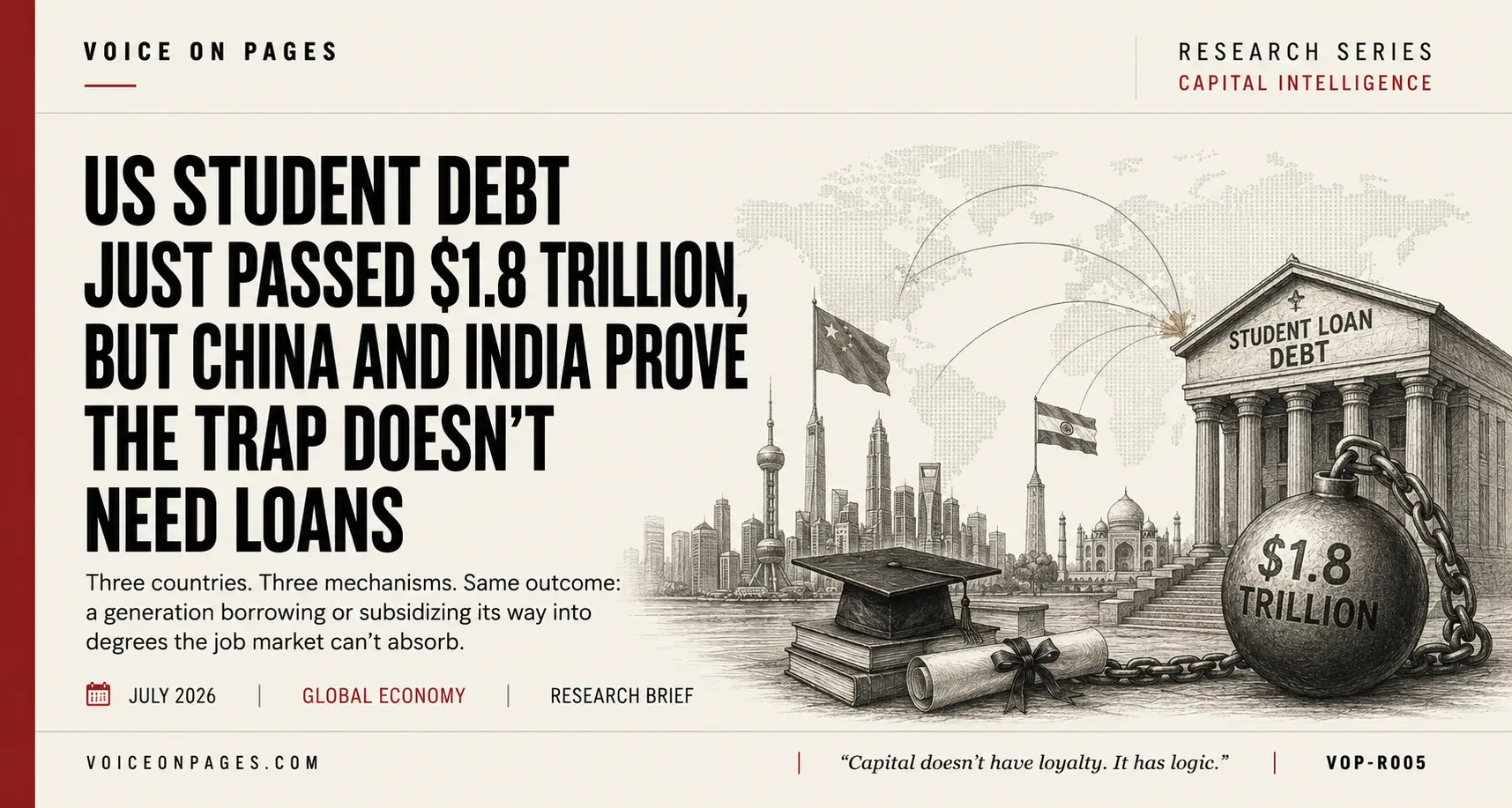
Quick Answer: US student loan debt has crossed $1.8 trillion across about 43 million borrowers, larger than the subprime mortgage market at its 2007 peak. But China, which never built an American-style loan system, still has youth unemployment near 16%. And India, growing its education loan book by 15% a year, is now building the same trap through a different door. Three countries, three mechanisms, one outcome: a generation borrowing or subsidizing its way into degrees the job market can’t absorb.
The US Numbers, Confirmed
As of 2025, total US student loan debt sits at roughly $1.8 trillion, held by about 43 million borrowers paying an average of $503 a month. The distress underneath that average is real: 10% of federal loan dollars were delinquent as of late 2025, and TransUnion recorded that 20.5% of borrowers with a payment due were 90 or more days delinquent in early 2025, the highest rate the firm has ever tracked. The Consumer Financial Protection Bureau found 37% of borrowers report having missed at least one payment.
Meanwhile, the institutions collecting tuition don’t need graduates to succeed to stay funded. At Harvard, only 22% of FY2025 operating revenue came from tuition, with 46% coming from philanthropy and endowment income alone contributing $2.5 billion, 37% of total revenue. Stanford’s endowment payout covers roughly a fifth of operating expenses on its own. The universities are financially insulated from whether their graduates find work. The debt sits entirely with the borrower, and unlike almost every other form of consumer debt in America, it survives bankruptcy.
On the lending side, the picture is murkier than a single “who profits” number allows. The federal loan portfolio itself is close to $1.7 trillion, and CBO analysis has shown the government turning a net profit on some loan categories over parts of the past decade, though newer projections point to losses as repayment plans shift. What’s harder to pin down is a clean annual interest-collected figure. No recent, authoritative single number for that exists publicly, so it’s worth being direct: the scale of the federal loan book is confirmed: a precise annual profit or interest total is not, and shouldn’t be treated as one.
China: The Same Outcome Without the Loans
China took a structurally different path. It subsidizes higher education heavily and never built a mass student loan system anywhere near America’s scale. And yet its youth unemployment rate peaked above 21% in June 2023, before officials suspended the metric entirely and relaunched it later that year under a new methodology. The revised figure came in at 16.3% as of April 2026, after dipping to 13.2% in mid-2024. China graduates around 12 million students a year, with roughly 12.7 million expected in 2026, and the underlying complaint, widely reported but not captured in a single clean statistic, is the same one American graduates voice: too many degrees, not enough matching jobs.
The mechanism is different. No loan crisis, no delinquency data, no securitized debt market. The outcome, a large cohort of educated young people unable to convert credentials into employment, looks familiar anyway.
India: Building the American Version, Faster
India’s trajectory is the one to watch closest, and the research here is unusually well grounded. India’s bank education loan book reached roughly 1.17 lakh crore rupees (about $14 billion) by January 2024, growing close to 15% annually. Non-performing loan rates on the public-sector portion have actually improved, falling from about 7% in FY2021 to 2% in FY2025 according to government data, though other analyses put the broader default rate closer to 7 to 8%.
The stress shows up more clearly on the employment side. India produces roughly 1.5 million engineering graduates a year, but independent labor-market data suggests only 10 to 20% find timely, degree-relevant jobs, a range corroborated separately by an AICTE-based placement survey showing enormous variation by branch: 94.5% placement for computer science graduates against just 42% for civil engineering. Reports of major employers, including Oracle in 2026, rescinding or delaying offers at top-tier IITs and NITs are well documented in the press, though there’s no single consolidated national dataset tallying every rescission, so that specific claim should be treated as illustrative, not a precise count.
The personal math is stark. The average loan for studying abroad rose to roughly 33 lakh rupees in FY2024, while the average starting salary for a new Indian graduate sits around 20,000 rupees a month. At that gap, a family clears a decade of repayment before it can begin building any wealth at all.
The Historical Parallel: Bigger Than 2008
At its peak in 2007, the US subprime mortgage market totaled about $1.3 trillion, roughly 13% of the total mortgage market at the time, and its collapse triggered the global financial crisis. Today’s student debt, at $1.8 trillion, is larger. Both markets share real structural DNA: heavy securitization, government-linked guarantees, and systemic scale. The difference that matters most: mortgage debt could usually be discharged in bankruptcy or resolved through foreclosure. Student debt, in nearly all cases, cannot be discharged at all. It follows the borrower indefinitely.
The UK: A System Built to Not Be Repaid
England offers the clearest evidence that a loan system doesn’t need to function as a loan system to serve its purpose. The average graduate there leaves university owing about £44,940. The UK’s own Department for Education forecasts that 56% of full-time undergraduate borrowers are not expected to repay their loans in full before the balance is written off entirely. That’s not a system failing. That’s the system working as designed: the government extends the credit, universities collect the tuition regardless of outcome, and the write-off is priced in from the start.
What Changes on July 1, 2026
The US system is about to shift meaningfully. Starting July 1, 2026, the Grad PLUS loan program is eliminated for new borrowers, replaced by new annual and lifetime borrowing caps. A new Repayment Assistance Plan (RAP) becomes available, tying payments to 1 to 10% of income and extending forgiveness out to 30 years, longer than most current income-driven plans. The Biden-era SAVE plan, already frozen by courts, is being wound down entirely, moving an estimated 7 to 8 million borrowers into other repayment tracks.
The Bottom Line
Three governments, three completely different approaches: heavy private lending in the US, heavy subsidy in China, rapid loan-market growth in India, and all three arrive at some version of the same problem. Degrees are being issued faster than jobs that justify them, and the institutions extending the credit or the education itself remain financially whole regardless of the outcome. The mechanism varies. The trap doesn’t.
Sources: Education Data Initiative, TransUnion, Consumer Financial Protection Bureau, Harvard University financial disclosures, Atlantic Council, Varthana, Press Information Bureau (India), Economic Times, US Office of Thrift Supervision, UK Department for Education, and Liberty University Student Financial Services, verified via Perplexity, 2026.