How Russia Used Environmental Law to Force Shell Out of Sakhalin-2
Executive Summary
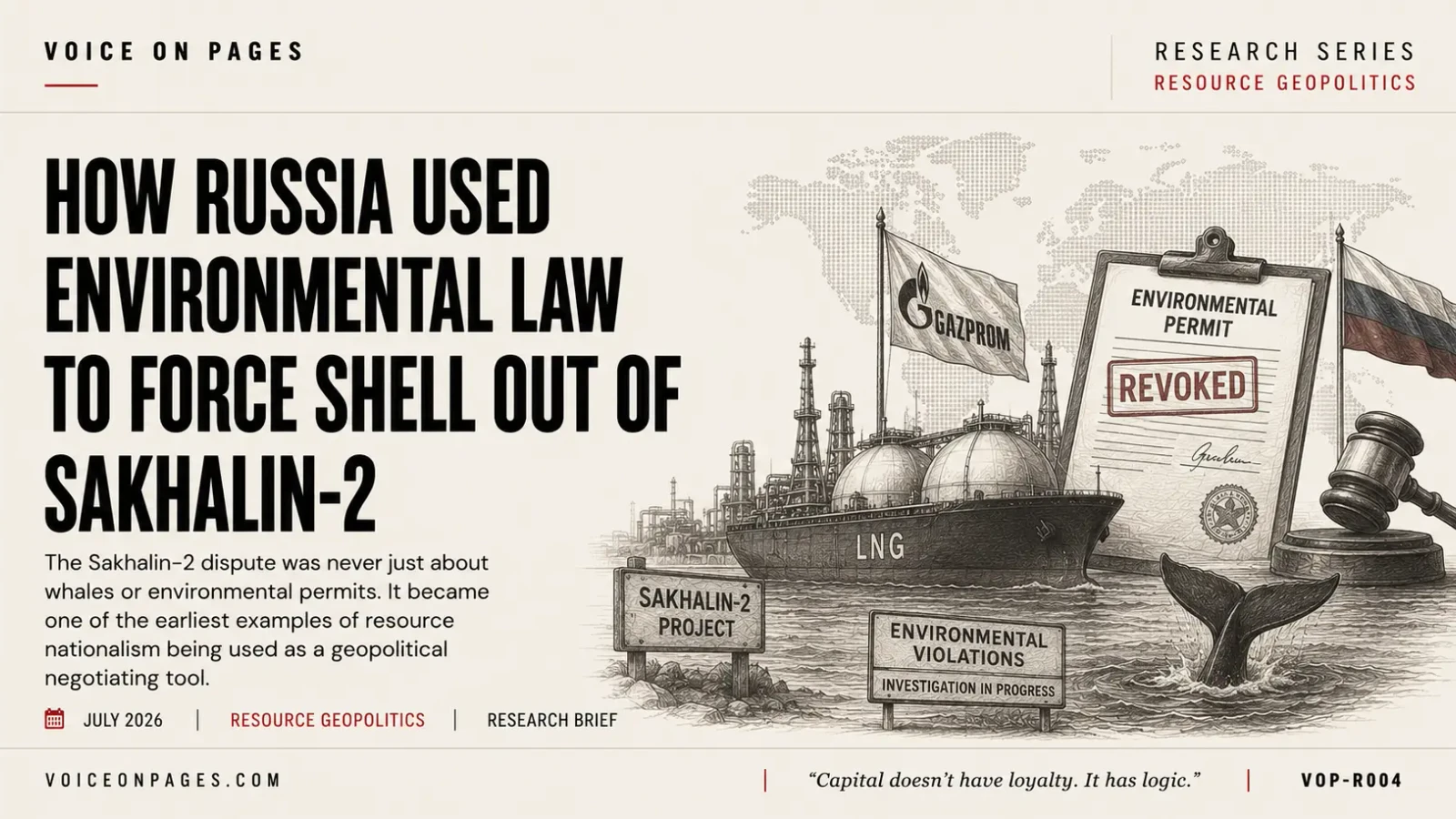
In December 2006, Gazprom acquired control of one of the world’s largest LNG projects after months of escalating environmental investigations against Shell’s Sakhalin-2 venture.
Officially, the dispute centered on environmental protection.
In practice, it demonstrated how environmental regulation, legal pressure, and contract structure could become instruments of strategic resource policy.
Nearly two decades later, many of the same legal mechanisms reappeared following Russia’s response to Western sanctions after 2022.
The Production Sharing Agreement That Changed Everything
The roots of the conflict began long before Gazprom entered the project.
Sakhalin-2 operated under a Production Sharing Agreement (PSA) negotiated during Russia’s economically weak post-Soviet period.
The agreement allowed Sakhalin Energy Investment Company (SEIC), led by Shell, to recover project costs before the Russian government received significant production revenues.
Independent legal and policy analyses concluded that Russia would only receive its larger share of project revenues after SEIC recovered its investment and achieved a 17.5% real rate of return.
This meant every increase in recoverable project costs delayed the point at which the Russian state benefited from its own natural resources.
Why Moscow Began Challenging the Costs
Russian officials increasingly questioned the project’s expanding cost base.
Audits commissioned by the Ministry of Industry and Energy challenged hundreds of millions of dollars in recoverable expenses.
Other investigations identified billions of dollars in project cost overruns, including contractor-related overruns exceeding $800 million.
While no public audit documented sensational examples such as luxury purchases or individual inflated invoices, the central criticism was structural:
The PSA imposed virtually no practical ceiling on recoverable costs, giving operators broad discretion over what expenses could ultimately be charged back before state revenues were shared.
The 2005 Budget Shock
Originally estimated near $10 billion, Sakhalin-2’s development budget nearly doubled during construction.
Shell attributed the increase to several factors:
- Higher global steel prices
- Rising contractor costs
- Dollar depreciation
- Technical complexity associated with the project
Russian officials viewed the explanation differently.
Because the PSA linked state revenues directly to cost recovery, every additional dollar of project expenditure postponed Russia’s participation in project profits.
Environmental Enforcement Becomes Strategic Pressure
By 2006, regulatory pressure intensified.
Russian authorities accused the project of violating environmental requirements involving rivers, pipeline construction, and protected ecosystems.
International attention focused on the Western Gray Whale population near Sakhalin Island.
Construction plans were revised, including approximately 20 kilometers of offshore pipeline rerouting around key whale feeding grounds.
On 18 September 2006, Russia’s Ministry of Natural Resources withdrew the project’s environmental approval, creating one of the largest regulatory crises faced by an international energy project in modern history.
Gazprom Takes Control
Only months after regulatory pressure reached its peak, Gazprom announced an agreement to acquire 50% plus one share of Sakhalin-2 for $7.45 billion.
Contemporary reporting noted a striking coincidence.
Following the agreement:
- Russia approved the revised project budget.
- Environmental disputes were effectively resolved.
- Project development resumed under Gazprom’s control.
Whether viewed as strategic negotiation or political pressure, the sequence fundamentally changed ownership of one of the world’s most important LNG projects.
The Blueprint Reappears After 2022
The Sakhalin-2 episode did not remain isolated.
Following Western sanctions after the invasion of Ukraine, Russia introduced Presidential Decree No. 416, restructuring the legal ownership of Sakhalin-2 through a newly created Russian limited liability company.
Foreign shareholders were required to seek recognition of their ownership interests under the new structure, while the Russian government retained broad authority over participation in the project.
The legal mechanism differed from 2006.
The strategic objective did not.
Control over critical energy infrastructure increasingly shifted from international operators toward domestic institutions under Russian jurisdiction.
Why Sakhalin-2 Still Matters
The Sakhalin-2 dispute illustrates an important shift in geopolitical competition.
Modern resource conflicts are no longer driven solely by military power or outright nationalization.
Governments increasingly rely on:
- Environmental regulation
- Domestic legal systems
- Licensing authority
- Corporate governance rules
- Sovereign control over strategic infrastructure
Together, these tools allow states to reshape ownership and bargaining power while maintaining a legal framework that can be defended domestically and internationally.
Signal
Sakhalin-2 was not simply an environmental dispute.
It demonstrated how legal institutions themselves can become strategic assets.
For investors, governments, and multinational corporations, the lesson remains relevant today:
The greatest geopolitical risks often emerge not through sudden expropriation, but through gradual changes in the legal architecture governing strategic resources.
Research Series: Resource Geopolitics Research Method: Multi-source verification using legal analyses, historical reporting, government documents, and industry publications referenced in the accompanying research dossier.