How Stablecoins Became a Structural Buyer for America’s $9 Trillion Treasury Refinancing Wall
The US Treasury must roll over roughly $10 trillion in maturing debt during 2026, and Washington’s own Treasury Secretary is publicly counting on dollar-pegged stablecoins, backed almost entirely by short-term Treasuries, to become one of the buyers that makes that possible.
What Actually Happened
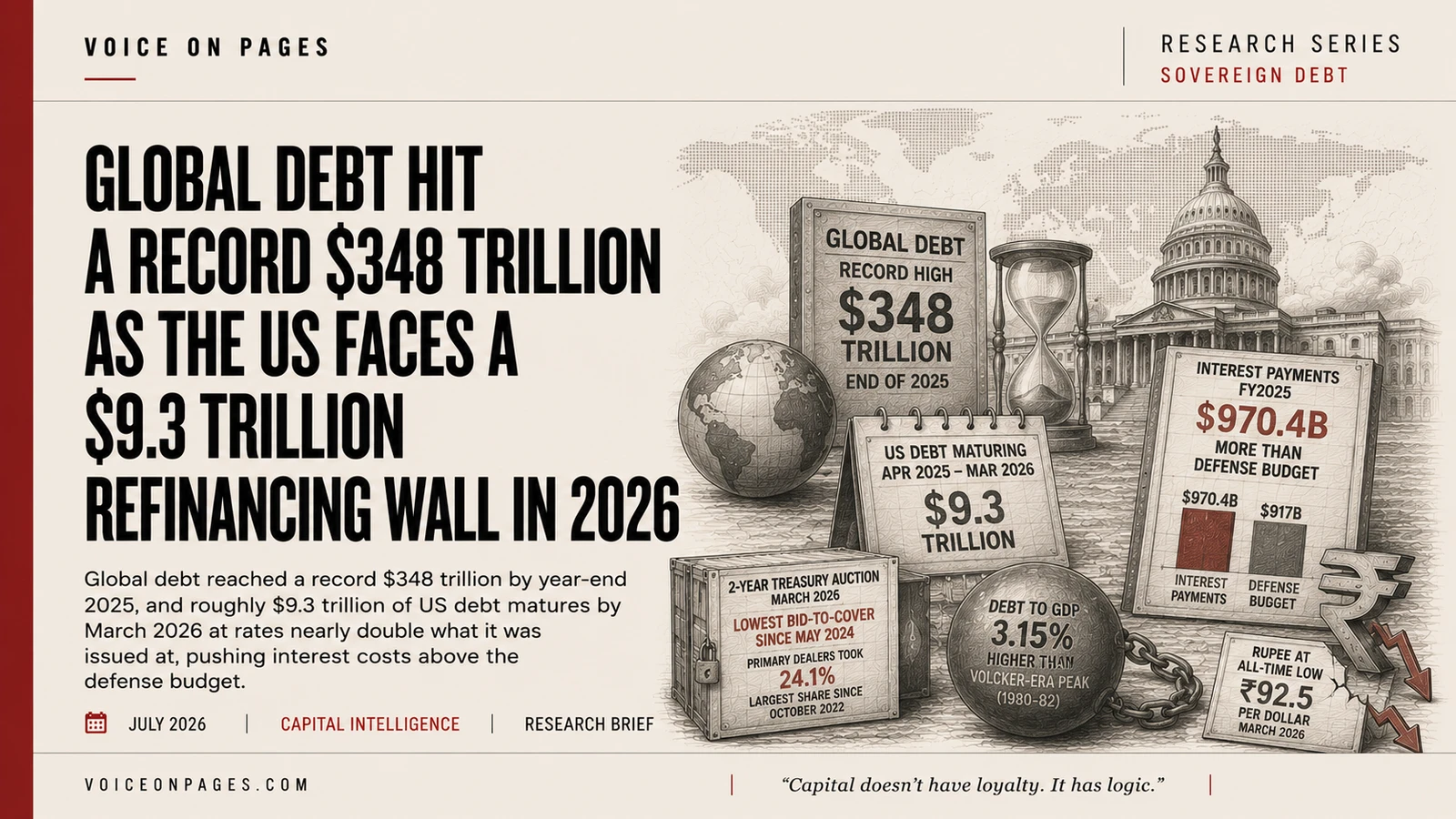
Deloitte estimates that about $9 trillion of marketable Treasury debt matures in 2026, on top of $9.2 trillion that matured by the end of 2025, meaning roughly a third of the entire marketable Treasury stock has to be refinanced every single year at current pace. Round that to the “about $10 trillion of Treasuries to refinance in 2026” figure that has circulated across market commentary, and add the separate figure for genuinely new borrowing, projected around $1.5-2 trillion in net new marketable debt for the fiscal year, and the scale of the financing task becomes clear: the US needs continuous, deep-pocketed buyers showing up every month, not just once.
This is the backdrop against which Treasury Secretary Scott Bessent has repeatedly pitched stablecoin legislation. He has told Congress that stablecoin rules requiring Treasury-backed reserves could create demand for at least an additional $2 trillion of Treasuries, and at the Treasury Market Conference he argued that the “payment stablecoin” market could grow tenfold, from around $300 billion currently to roughly $3 trillion by 2030, while simultaneously reinforcing the dollar’s reserve-currency status. The two goals, funding the deficit and defending dollar dominance, are explicitly linked in his own framing.
Who Actually Buys US Debt Right Now
The traditional buyer base splits roughly into domestic and foreign holders. About $27 trillion of Treasuries sit with domestic investors, including the Federal Reserve, mutual funds, banks, insurers, pensions, and households, as of mid-2025. Foreign investors hold roughly $9.3-9.4 trillion, about 24% of total US debt, led by Japan at $1.13-1.20 trillion, the UK at $0.81-0.89 trillion acting largely as a custody hub, and China at $0.73-0.76 trillion.
The narrative that foreign buyers are fleeing Treasuries doesn’t hold up in aggregate. Foreign holdings hit a record near $9.35 trillion in November 2025, up 7.2% year over year. What did change is composition: Bloomberg’s analysis found that US allies added about $463.9 billion of Treasuries in 2025 while less-aligned countries reduced holdings by roughly $125.2 billion, with China specifically cutting its stake to about $683.5 billion by end-2025, its lowest level since 2008. Demand rose overall, but it rotated away from geopolitical rivals and toward allies and private capital, which is precisely the gap stablecoins are being positioned to help fill.
The Mechanism: How a Crypto Token Becomes a Treasury Buyer
A dollar stablecoin is, in practical terms, a digital token pegged 1:1 to the dollar and backed by a reserve pool of cash and very short-dated US government securities. Issuers hold these reserves because T-bills are liquid, low-risk, and pay yield while the issuer profits on the spread. A BIS working paper found that stablecoins collectively held about $153 billion in T-bills as of December 2025, and Reuters-summarized analysis puts roughly 80% of total stablecoin reserves in T-bills or repo.
The two dominant issuers illustrate the scale. Tether’s total Treasury exposure, including direct holdings and reverse repo, had grown to roughly $135-141 billion by late 2025, a figure that analysts note would rank it around 17th among all global holders of US Treasuries, ahead of many sovereign nations and roughly comparable to mid-tier creditors like Saudi Arabia. Circle’s USDC reserves run 75-80% short-dated Treasuries and Treasury-backed repo, adding tens of billions more. Combined, Tether and Circle hold well over $160-180 billion in Treasuries and Treasury-backed repo, functioning collectively like a large sovereign holder that didn’t exist in this form five years ago.
The GENIUS Act, the federal stablecoin law now shaping this market, is explicit about the mechanism rather than accidental about it. It requires permitted payment stablecoins to be backed by high-quality liquid assets, primarily Treasuries maturing in under 93 days, cash, and Fed deposits. The Treasury Borrowing Advisory Committee’s own modeling estimates this could generate roughly $900 billion of incremental T-bill demand as adoption scales, and in the four months following the Act’s passage, stablecoin issuers reportedly purchased about $109 billion in T-bills. The global stablecoin market currently sits around $300-320 billion in total capitalization, with credible forecasts from Citi and others clustering around $1.5-2 trillion by 2030 in a base case, and as high as $3-4 trillion in bull scenarios.
The Risk Regulators Actually Fear
None of this comes without a documented failure mode. Fiat-backed stablecoins issue demandable liabilities, redeemable at $1 on demand, backed by less liquid assets like T-bills and repo, which is classic liquidity-transformation risk. In a large redemption event, issuers first draw down cash buffers, then sell Treasuries or unwind repo positions to raise dollars, potentially at a discount if markets are already under stress. BIS and Federal Reserve-affiliated research shows this can depress T-bill prices and widen short-term yields, with extreme scenarios pushing an issuer’s capital below zero.
Terra/Luna remains the reference case for how badly this can go, even though it was an algorithmic stablecoin rather than a Treasury-backed one: in May 2022, its collapse wiped out roughly $45-50 billion in direct market capitalization within days, with knock-on losses across crypto markets estimated near $400 billion. The Financial Stability Board’s own assessments now treat large, cross-border stablecoins as potential systemic payment infrastructure requiring bank-like oversight, and an IMF paper explicitly warns that stablecoin runs “could trigger fire sales of the underlying reserve assets, potentially impairing market functioning.” No regulator has published a single definitive worst-case number, but bracketing current holdings suggests an extreme, system-wide run could plausibly force $150-200 billion of Treasury sales in a short window, a scale large enough to transmit stress into short-term funding markets even though it’s still small next to the broader multi-trillion-dollar T-bill market.
The India Angle: Sovereignty, Not Just Payments
India’s own digital payments infrastructure dwarfs stablecoins in raw transaction volume. UPI processed 21.7 billion transactions worth ₹28.33 lakh crore in a single month in January 2026 alone, and full-year FY2025-26 volumes reached roughly 241.6 billion transactions. The Reserve Bank of India’s own Digital Rupee (e₹) pilot, launched in December 2022, has expanded to over 50 banks and 1.5 crore-plus registered retail users, though circulation remains modest next to cash and bank deposits.
The concern isn’t payments infrastructure, it’s currency substitution. The RBI’s December 2025 Financial Stability Report explicitly warns that widespread adoption of foreign-currency stablecoins could erode India’s monetary control, weaken policy transmission, and circumvent capital-flow management rules. A BIS paper on stablecoins and the international monetary system notes that because roughly 98% of stablecoin value is dollar-denominated, their spread functions as “digital dollarisation” rather than genuine competition with domestic payment rails. Case studies from Argentina, Egypt, and Brazil already show dollar stablecoins used as inflation hedges and stores of value in exactly the way regulators warn about, often easier to access locally than physical dollars.
The Turn: Stablecoins Are Reinforcing the Dollar, Not Replacing It
The most counterintuitive finding across this research is also the most consistent one: nearly every serious analysis, IMF, Citi, JPMorgan, the US Treasury itself, concludes that dollar stablecoins strengthen dollar dominance rather than threaten it. An IMF Finance & Development article argues dollar stablecoins reinforce the “world banker” balance sheet of the United States by boosting Treasury demand. The official House summary of the GENIUS Act states outright that stablecoins “will drive demand for U.S. Treasuries and ensure the U.S. dollar remains the reserve currency of the world.”
European regulators see the same mechanism and worry about it from the other side. ECB Executive Board member Isabel Schnabel has flagged three systemic risks from dollar-stablecoin adoption in Europe: bank runs and fire-sales, disruption of monetary policy transmission, and the cementing of US dollar dominance at the euro’s expense. The closest historical parallel researchers point to is the Eurodollar system, the offshore dollar deposit market that grew from the 1950s onward, largely outside direct US regulatory reach, yet ended up reinforcing rather than undermining the dollar’s global role. Several recent papers explicitly frame dollar stablecoins as a digital-era repeat of that pattern: a new, partly offshore layer that extends the dollar’s reach and creates fresh demand for US safe assets, while introducing new, harder-to-regulate fragility.
The Bottom Line
The refinancing wall is real, the buyer-base rotation away from geopolitical rivals is real, and Washington’s own policy architecture now treats stablecoins as a deliberate tool to plug that gap rather than a side effect of crypto regulation. What isn’t supported by the evidence is the idea that this represents dollar weakness. It’s closer to the opposite: a coordinated bet that digitizing the dollar, and quietly making crypto issuers into structural Treasury buyers, extends dollar dominance further into the next decade even as the debt it finances keeps growing. Because in the end, capital doesn’t have loyalty. It has logic, and right now the logic runs through a stablecoin reserve account holding your government’s own IOUs.
Sources: Deloitte, Fortune, Wells Fargo, US Treasury/TBAC, Reuters, Bloomberg, BIS, Federal Reserve, IMF, Financial Stability Board, RBI Financial Stability Report, Citi Research, J.P. Morgan Research, verified via Perplexity, July 2026.