Why India Attracted $81 Billion in Foreign Investment While Global Capital Repositioned
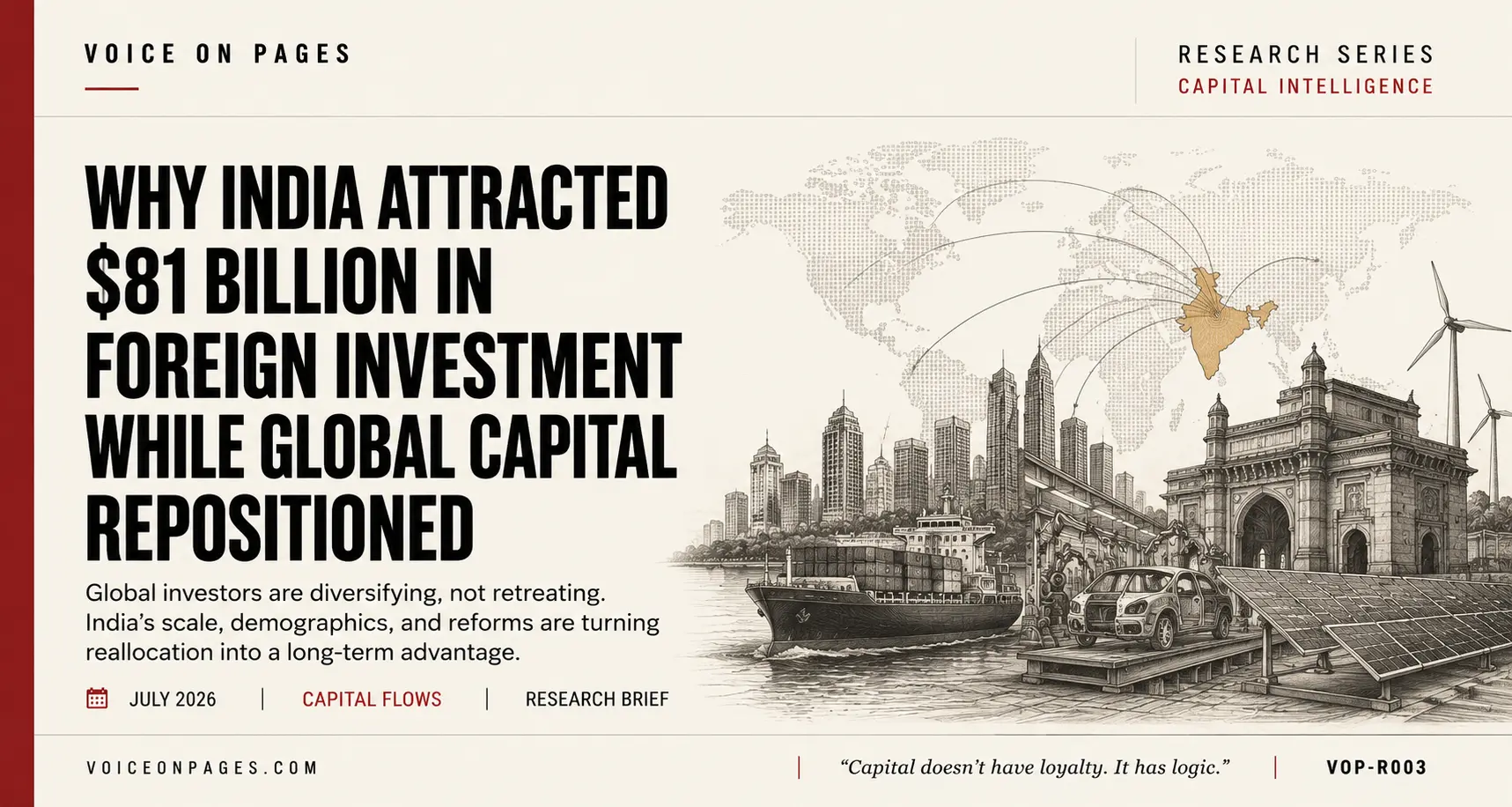
Quick Answer: India attracted $81.04 billion in foreign direct investment during FY2024–25, even as global investors reassessed portfolios amid higher interest rates, geopolitical fragmentation, and supply-chain restructuring. Rather than abandoning the United States, institutional capital increasingly diversified across multiple growth markets, with India emerging as one of the largest beneficiaries.
What Actually Happened
India recorded $81.04 billion in total foreign direct investment during FY2024–25, representing a 14% increase over the previous fiscal year. The inflows were driven by investments across services, manufacturing, and technology, reinforcing India’s position as one of the world’s most attractive long-term investment destinations.
The broader global story, however, is more nuanced than many headlines suggest.
The research does not support the idea of a broad capital flight from the United States. Instead, foreign investors continued purchasing U.S. financial assets overall, while some major holders—including China and India—reduced portions of their U.S. Treasury exposure. The evidence points toward portfolio diversification rather than a wholesale exit from American markets.
That distinction matters because it changes the narrative from one of panic to one of strategic capital allocation.
Capital Is Being Reallocated, Not Simply Relocated
Institutional investors increasingly face a world defined by geopolitical competition, supply-chain resilience, and higher financing costs.
Rather than concentrating capital in a single geography, sovereign wealth funds, pension funds, and multinational corporations are expanding exposure across several regions simultaneously.
The research identifies institutions including Norway’s Norges Bank Investment Management, Abu Dhabi Investment Authority, Singapore’s GIC, Temasek, and the Kuwait Investment Authority among investors with confirmed India exposure during 2024–2025. Foreign pension fund equity assets in India also increased during the period despite more cautious sovereign fund deployment.
Large institutional investors rarely replace one country with another overnight. Instead, they gradually rebalance portfolios toward regions offering stronger long-term growth, demographic advantages, and expanding domestic markets.
Why India Continues to Attract Capital
Several structural factors continue to distinguish India from many other emerging markets.
The research identifies a working-age population representing roughly 68% of the country’s population, supported by a relatively young demographic profile. Equity market liquidity also continued improving during FY2024–25, with average daily turnover rising significantly year over year.
At the same time, multinational manufacturers continue expanding production capacity inside India.
Apple’s manufacturing footprint illustrates this trend. According to the research, production reached approximately 55 million iPhones during 2025, representing a substantial increase from the previous year, while Foxconn announced an additional $1.5 billion investment into its Indian operations.
The picture is not entirely one-sided.
India’s dependence on Chinese imports remains substantial, with imports from China continuing to rise overall despite reductions across several product categories. That means India is successfully attracting higher-value manufacturing investment while remaining reliant on imported industrial inputs in several sectors.
The opportunity is therefore real—but still incomplete.
Where the Money Is Going
Foreign investment has not flowed evenly across the economy.
Services remained the largest recipient of FDI during FY2024–25, while computer software, hardware, and manufacturing also attracted significant investment. Semiconductor manufacturing emerged as one of the fastest-growing strategic sectors, supported by multiple approved projects valued at approximately ₹1.6 trillion.
Renewable energy also strengthened its position. The research indicates that renewable energy accounted for an expanding share of India’s foreign investment and attracted billions of dollars in new capital during FY2024–25 as India’s clean-energy transition accelerated.
These sectors are directly connected to long-term industrial policy rather than short-term market cycles.
Why Domestic Investors Matter More Than Ever
One of the most surprising findings in the research is that India’s equity market remained resilient despite substantial foreign portfolio selling.
Systematic Investment Plan (SIP) contributions exceeded ₹3 trillion during 2025 for the first time, while mutual fund assets continued expanding rapidly. During the same period, foreign institutional investors recorded significant net equity outflows.
Domestic investors effectively absorbed much of that selling pressure, allowing benchmark indices to remain resilient despite weaker foreign portfolio flows.
For decades, Indian equity markets were heavily influenced by foreign institutional flows. Today, India’s growing domestic investor base provides an increasingly independent source of market liquidity.
India Is Leading—But It Is Not Alone
India is part of a broader reallocation of global investment toward emerging markets.
The research identifies Vietnam, Mexico, Indonesia, and the United Arab Emirates as other major beneficiaries of recent capital flows, each attracting substantial foreign investment through different competitive advantages, including manufacturing, nearshoring, industrial metals, and logistics.
The current investment cycle is not a single-country story. It is a regional restructuring of global production and capital allocation.
India’s significance lies less in attracting investment alone than in emerging as one of the largest and most diversified destinations within that wider shift.
The Bottom Line
India’s $81.04 billion in foreign direct investment is not evidence that investors have abandoned the United States. It is evidence that global capital is becoming more diversified, more selective, and increasingly driven by long-term structural opportunities rather than geographic concentration alone.
For India, the challenge now is not attracting capital—it is converting that capital into sustained productivity, manufacturing capability, and technological leadership.
Because in the end, capital doesn’t have loyalty. It has logic.
Sources: Department for Promotion of Industry and Internal Trade (DPIIT), Press Information Bureau, Reuters, Institute of International Finance, official government publications, and institutional data, as compiled in the supplied Perplexity research documents.