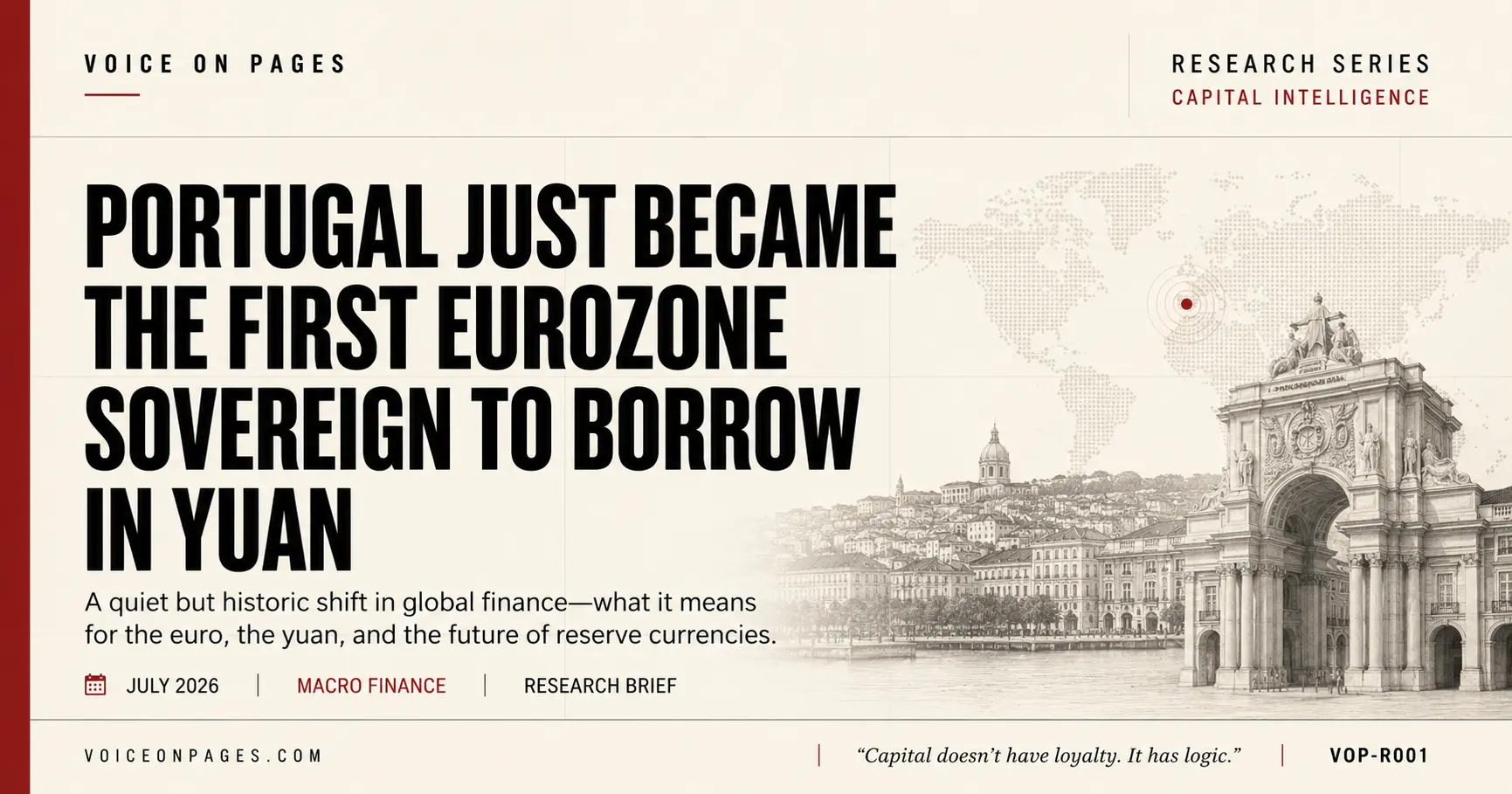
Portugal Just Became the First Eurozone Sovereign to Borrow in Yuan - And It Was Cheaper Than Euros
Quick Answer: On April 9, 2026, Portugal’s debt agency (IGCP) issued CNH 1.99 billion in 8-year offshore renminbi bonds at a 1.765% coupon - well below the roughly 3.2% it would have paid in euros at the same maturity. It’s the first offshore yuan bond ever issued by a euro-area sovereign, and Portugal’s own debt office says the motive was cost, not politics.
The Deal: What Actually Happened
Portugal’s IGCP priced CNH 1.99 billion (about €249 million, roughly $291.7 million) of 8-year sovereign debt in a private placement on April 9, 2026, at a fixed coupon of 1.765%. The size and terms are confirmed consistently across IGCP’s own official note, Bloomberg, Caixin, and ECO News.
This matters for framing: it’s a fresh, current deal, not an overlooked move from years back. Portugal hasn’t quietly been doing this - it happened this year.
The Paradox: Cheaper, Not Political
The obvious question is why a euro-area government would borrow in a foreign currency it doesn’t control. The answer, according to IGCP’s own communiqué, is arithmetic.
At the time of issuance, Portugal’s 8-year euro-denominated yield in the secondary market sat around 3.2%, with 10-year yields closer to 3.3–3.5%. The yuan bond’s coupon was 1.765%. IGCP states directly that it executed interest-rate and FX hedges alongside the issuance specifically to bring the all-in, euro-equivalent cost below what comparable Portuguese government bonds were trading at.
In plain terms: after hedging back to euros, borrowing in yuan was still cheaper than borrowing in euros directly. That’s not a diversification gesture, it’s a debt office doing its job.
Who Arranged It
The placement was managed jointly by Deutsche Bank and Industrial & Commercial Bank of China (ICBC) - a Western bank and a Chinese state bank in the same syndicate. This is the standard pattern in offshore RMB issuance: Chinese state banks provide access to yuan clearing infrastructure, while banks like Deutsche Bank, HSBC, and BNP Paribas bring existing sovereign relationships and distribution. Yuan internationalization, at least here, isn’t bypassing Western finance, it’s running directly through it.
Portugal Isn’t First to Touch Yuan, But Is First Offshore
It’s worth being precise about the “first” claim, because the full picture is more interesting than a clean firstmover story.
Poland and Hungary both issued onshore panda bonds in yuan years earlier, Poland via a Bank of China-arranged deal, Hungary with a green panda bond in December 2021. Portugal itself issued a 2 billion yuan panda bond back in 2019, its finance minister at the time calling it a step in managing external debt.
What’s actually new here is the offshore dim sum structure, bonds settled outside mainland China’s regulatory system, in this case very likely through Hong Kong’s clearing infrastructure. No other major euro-area sovereign, not Germany, not France, has touched either panda or dim sum bonds. Portugal is the first euro-area sovereign in the offshore yuan market specifically, arriving on the back of its own earlier onshore experiment.
The Market Portugal Just Joined Is Growing Fast
Offshore yuan (dim sum) bond issuance has expanded for eight straight years: from roughly ¥300 billion in 2021 to about ¥850 billion in 2024, crossing ¥1 trillion for the first time that year, and reaching over ¥1.1 trillion by December 2025. This isn’t a niche instrument Portugal stumbled into, it’s an accelerating, institutionally-trafficked market that a AA-rated sovereign chose to enter deliberately.
What This Means for India
Here’s where the evidence gets more cautious, and it’s worth being honest about what wasn’t found as much as what was.
India–China trade hit a record $155 billion in 2025. But there’s no reliable public data breaking out what share of that trade settles in yuan specifically. What is clear: the RBI has been building rupee-settlement infrastructure since 2022 (via Special Rupee Vostro Accounts), and in 2023 explicitly discouraged banks from using yuan for payments related to Russia, citing discomfort given political tensions.
So the honest read is not “India is already moving toward yuan and Portugal confirms it.” It’s the opposite: India has been actively avoiding yuan settlement while building out its own currency’s international footprint. What Portugal’s move does provide is political cover, if a NATO member and eurozone founding-era economy can borrow in yuan purely on cost grounds, it becomes harder to frame any future Indian exploration of yuan instruments as geopolitically compromising. There are early, pre-decision signals that India is considering enabling yuan transactions at GIFT City, but that remains at the exploratory stage, not a policy shift.
Who Actually Wins From This
The institutional beneficiaries are specific, not abstract. Hong Kong remains the dominant clearing hub for offshore RMB and has been since the dim sum market’s origin in 2007, its share of the growing market keeps it structurally advantaged regardless of who issues next. Chinese state banks (Bank of China, ICBC) continue to anchor these syndicates. And a small set of European financial centers, Luxembourg (the largest listing venue for dim sum bonds), Frankfurt, and London; along with Western banks holding RMB clearing licenses, earn arrangement and market-making fees each time a new sovereign follows Portugal’s path.
The Bottom Line
Portugal didn’t make a political statement by issuing yuan debt, its own debt office says explicitly that the trade was cheaper, after hedging, than staying in euros. That’s the kind of decision that’s easy for other sovereigns to justify following, since it requires no ideological framing, just a spreadsheet. Watch whether any other euro-area state — particularly one with less pristine credit than Portugal’s current A-range ratings — follows into the offshore yuan market next. If the cost advantage holds, it likely will.
Sources: IGCP official communiqués, Bloomberg, Caixin Global, ECO News, and additional verification via Perplexity research, April 2026.