Overview
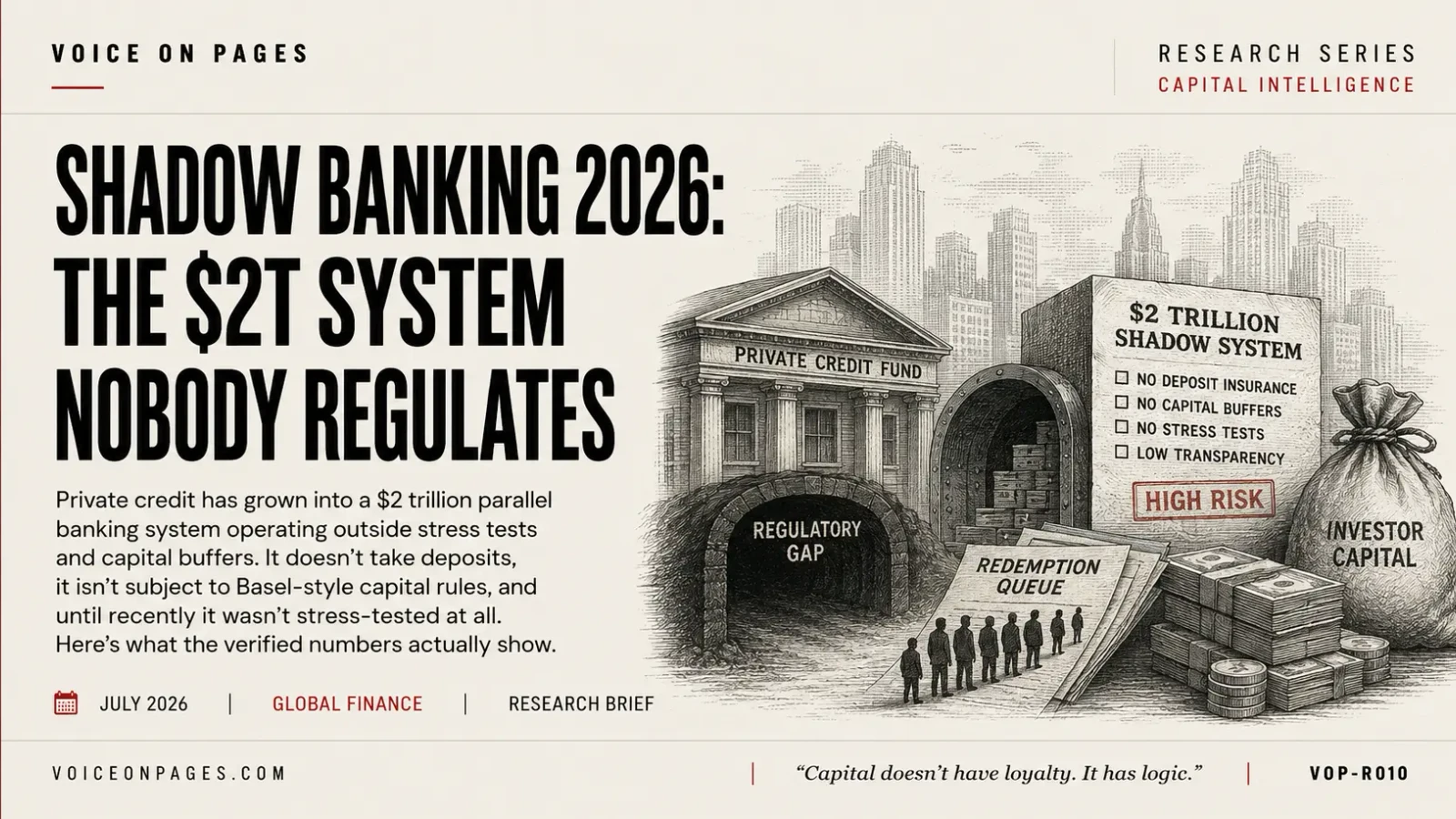
Private credit is now a roughly $2 trillion system that sits mostly outside the regulatory framework built for banks after 2008. It doesn’t take deposits, it isn’t subject to Basel-style capital rules, and until recently it wasn’t stress-tested at all. It also doesn’t fail loudly — it fails through redemption queues, quiet mark-downs, and gates that keep investors from pulling their money out fast enough to matter.
The system is real, the growth is real, and the risk is more nuanced than either the “hidden $2 trillion time bomb” framing or the “nothing to see here” framing suggests. Here’s what the verified data actually shows. [1]
The Scale
Estimates of private credit assets under management cluster between $1.8 and $2.1 trillion as of 2026, depending on which tracker you use — PwC puts it above $2 trillion with a base case of $3.4 trillion by 2030, while the Financial Stability Board’s own estimate sits closer to the $1.5–2 trillion range. [1][5] There’s no single official number because there’s no single regulator collecting one. That absence is itself the story: banks report standardized data to central banks on a quarterly cycle; private credit funds report what they choose to disclose to their own investors.
What’s not disputed is the direction. From roughly $280 billion in assets under management in 2007, the sector has grown five-to-sevenfold in under two decades, while banks’ share of U.S. corporate lending fell from about 48% to 29% between 2015 and 2025 as non-bank lenders absorbed the difference. [8] That’s a genuine structural shift in who finances the real economy, not a rounding error.
The Regulatory Gap
There’s no clean statistic for “what percentage of private credit funds operate without stress tests” — because stress testing this sector barely exists yet. The Bank of England only launched its first system-wide stress test of private markets in late 2025, and participation is voluntary. In the U.S., a March 2026 congressional appropriations document explicitly asked regulators to design an exploratory stress test for non-bank private credit lenders — a request, not a rule. [7] The accurate framing isn’t “X% lack stress tests,” it’s that formal, mandatory, bank-style stress testing of this sector is still in its pilot phase, years after the sector itself scaled into the trillions.
Defaults Are Rising — Faster Than the Popular Narrative Suggests
Default figures vary sharply by methodology, and the spread matters. Fitch’s monitored portfolio of 302 U.S. middle-market borrowers showed defaults at 9.2% in 2025, up from 8.1% the year before. Proskauer’s narrower index of senior-secured, unitranche loans showed 2.73% in Q1 2026, up from 1.84% just two quarters earlier. [2][3] Both are moving in the same direction — up — even though the headline number depends heavily on which slice of the market you’re measuring. The trend line matters more than any single figure here.
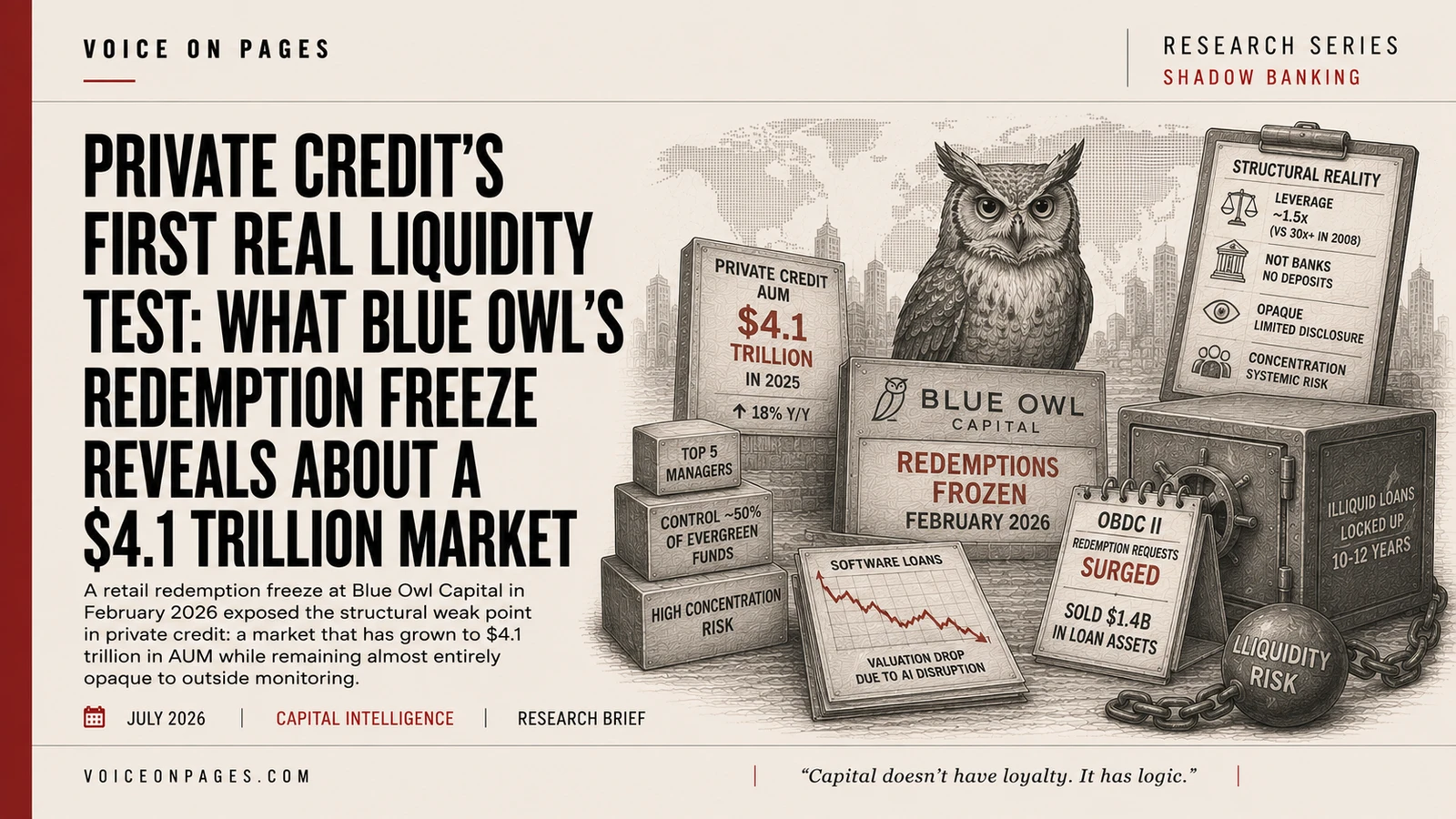
Redemption pressure backs this up with a cleaner number: roughly $12 billion in redemption requests hit major retail-facing private credit funds in Q2 2026, a 56% jump from the prior quarter. [4] When investors in a fund holding illiquid, multi-year loans all try to leave through a door sized for quarterly redemptions capped at 5% of net asset value, the fund doesn’t have a clean way to meet that demand — it either gates redemptions, sells into a thin secondary market at a discount, or both.
Who’s Actually Exposed
Private credit still finances a minority of total corporate lending — somewhere between 6% and 10% depending on the source, not a majority position. [6] But that share is concentrated. Real estate, healthcare, technology, and private-equity-backed mid-market companies are the heaviest users, and healthcare alone accounted for 19% of 2025 direct-lending deal volume.
The capital funding these loans is overwhelmingly institutional. Pension funds make up roughly 30% of the investor base, insurers another 18% — meaning close to half of private credit’s capital ultimately traces back to retirement savings and insurance reserves, not hedge fund speculation. [6] U.S. public pensions raised their private credit allocations from 2.9% of assets in 2020 to 4% by 2024. That’s the actual transmission channel between a private credit stumble and ordinary household balance sheets: not direct retail exposure, but indirect exposure through the institutions managing retirement money.
The Subprime Comparison — Real, But Not Exact
The parallels to 2008 are genuine and worth naming precisely: weaker borrower underwriting, opacity in valuation, and risk migrating outside the regulated banking perimeter are all common features of both eras. Analysts at multiple research houses have drawn this comparison directly. [1] But the differences matter too — private credit funds generally carry less leverage than the securitization chains that collapsed in 2007–08, and they rely less on short-term funding markets, which was the specific mechanism that turned a housing problem into a banking panic. The honest read: private credit shares subprime’s structural vulnerabilities — weak underwriting, opacity, regulatory arbitrage — without yet sharing its leverage profile. That could change as the sector matures under redemption pressure.
Covenant Erosion Is Real, But Overstated in Isolation
Covenant-lite loans — deals stripped of the financial maintenance tests that let lenders intervene early when a borrower weakens — rose to roughly 21–26% of private credit transactions by 2025, up sharply from single digits just two years earlier. That’s a real erosion of lender protection. But it’s still well below the 90%+ covenant-lite share in the broadly syndicated loan market. Private credit remains, for now, the more protected corner of leveraged lending — the trend line is the concern, not the current absolute level.
The Concentration Problem
A small number of managers run an outsized share of this system. Blackstone alone manages roughly $354 billion in private credit-related assets, Ares around $335 billion, and estimates suggest the four largest players — Apollo, Ares, Blackstone, and Blue Owl — control more than 60% of the sector’s roughly $2.1 trillion in total credit assets. That concentration means a stumble at any one of these firms carries systemic weight disproportionate to any single bank failure of comparable size, precisely because there’s no deposit insurance, no lender-of-last-resort backstop, and no resolution framework built for this structure.
The On-Chain Alternative — Small, But Structurally Different
Tokenized, on-chain private credit is real but tiny: active loans sit around $18–19 billion, with roughly $5 billion in fully tokenized, DeFi-composable form — under 1% of the traditional private credit market. [8] Maple Finance dominates this niche with over 90% share of the tracked subset. The genuine advantage isn’t scale, it’s transparency: on-chain loan performance, collateral, and repayment data are visible in real time on a public ledger, in direct contrast to the “opaque and unrated” description regulators consistently apply to traditional private credit. [6] Whether this segment scales enough to matter for systemic risk is an open question — right now it’s a structural proof of concept, not a hedge against the larger system’s opacity.
What to Actually Watch
Rather than waiting for headline default rates to spike, the more useful leading indicators are already visible: rising non-accrual and payment-in-kind rates at large business development companies, growing use of redemption gates in interval funds, and widening discounts-to-net-asset-value in listed BDC share prices. All three tend to move before formal default statistics catch up. [5]
The Bottom Line
The $2 trillion figure is directionally accurate, if imprecise. The regulatory vacuum is real and only now beginning to close. Default rates are rising, not stable. And the risk, while genuine, is currently concentrated in specific vehicles and redemption mechanics rather than posing an immediate system-wide threat on the scale of 2008. The system bears watching closely — not because a crisis is guaranteed, but because it’s now large enough, concentrated enough, and opaque enough that nobody, including its own regulators, can currently rule one out with confidence.