Modi’s Economic Diplomacy Helps Indian Companies Abroad—But the Evidence Doesn’t Support a Unique “Modi–Adani Pattern”
Quick Answer
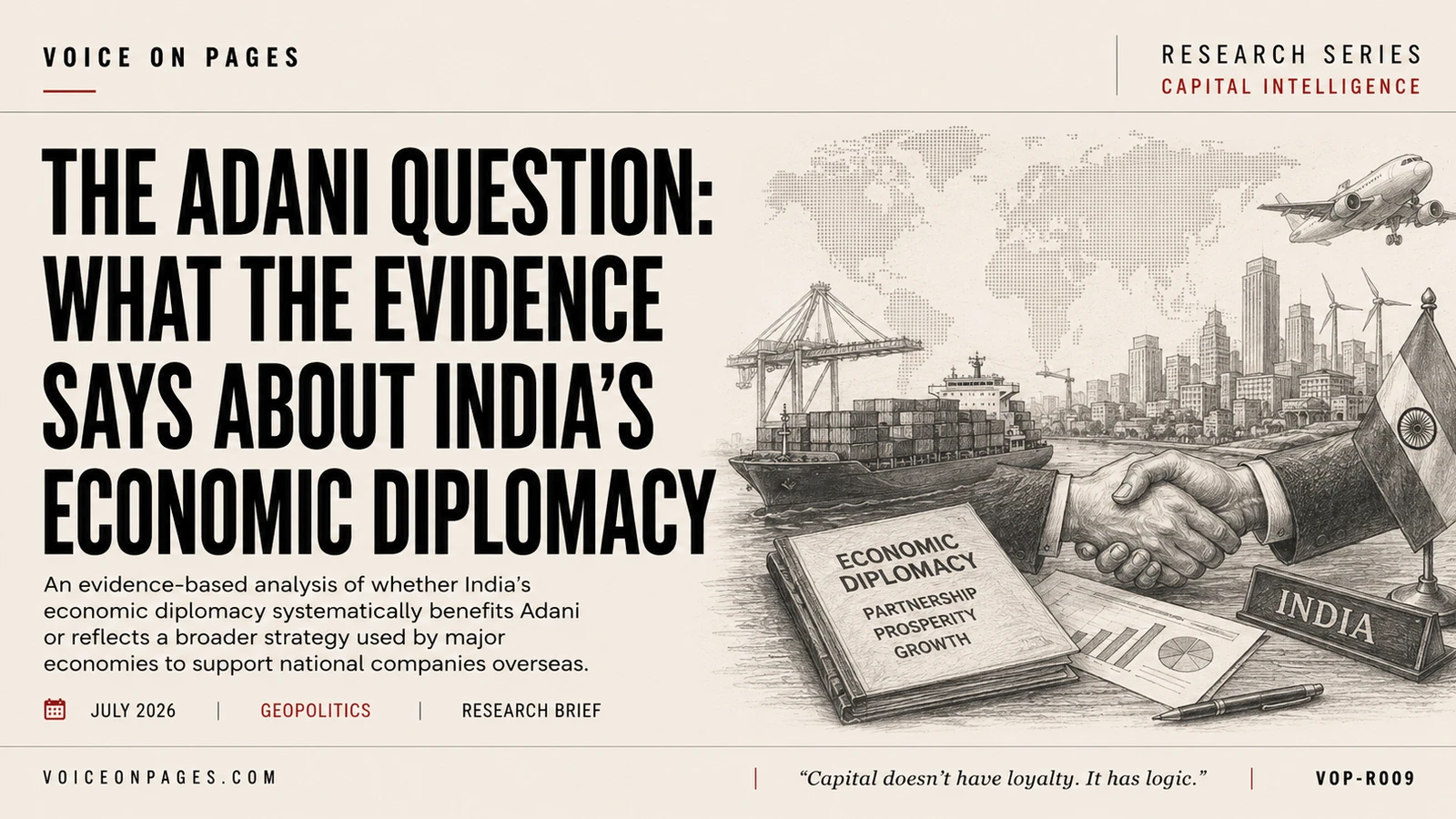
India’s foreign policy explicitly uses economic diplomacy to help Indian companies expand overseas. The evidence shows Adani benefited in several high-profile cases—particularly Sri Lanka—but current public data does not support the stronger claim that Adani uniquely benefits compared with all other Indian firms.
What Actually Happened
The debate surrounding Prime Minister Narendra Modi’s overseas visits often focuses on whether diplomatic engagement translates into commercial success for Indian companies, especially the Adani Group.
The available evidence supports one part of that argument but not all of it.
Official Ministry of External Affairs documents show economic diplomacy is an explicit policy objective. Business delegations, CEO roundtables, export promotion, and investment facilitation are built into many high-level visits.
However, proving a company-specific advantage requires far more than anecdotal examples.
Economic Diplomacy Is Official Indian Policy
MEA annual reports describe economic diplomacy as a dedicated function of Indian foreign policy.
Indian embassies identify commercial opportunities, organize business events, coordinate with industry associations including CII, FICCI and ASSOCHAM, and help Indian firms navigate overseas markets.
The stated objective is to create conditions that support India’s economic development through international engagement.
Where Adani Clearly Benefited
Among all publicly documented cases, Sri Lanka’s Colombo West International Container Terminal provides the strongest evidence of direct diplomatic facilitation.
Following the collapse of the earlier East Container Terminal agreement, India actively supported an alternative government-to-government framework in which Adani Ports became India’s nominated partner.
Other projects—including Haifa Port in Israel—occurred within a broader strategic deepening of India-Israel relations, although the acquisition itself resulted from a competitive privatization process.
In Tanzania, Kenya and Vietnam, the evidence is substantially weaker. Those investments align with India’s broader Indo-Pacific and Africa strategies but cannot be directly attributed to specific diplomatic visits.
Adani Is Not the Only Company
The broader record shows multiple Indian companies have expanded internationally with diplomatic support.
ONGC Videsh and other public-sector energy companies maintain dozens of overseas assets.
Larsen & Toubro has secured major EPC contracts across the Gulf and Africa.
GMR has operated international airport concessions.
These examples indicate that India’s diplomatic machinery supports a wider ecosystem of Indian companies rather than a single corporate group.
International Comparison
India’s approach is not unusual.
China integrates diplomacy with state-owned enterprises through the Belt and Road Initiative.
Japan coordinates infrastructure exports through JICA, JBIC and METI.
South Korea combines presidential economic missions with export finance.
The United States uses commercial diplomacy through the State Department, Commerce Department, EXIM and the Development Finance Corporation.
India follows the same general model but with fewer institutional resources and a smaller diplomatic network.
Why the Evidence Stops Short
To statistically demonstrate a unique Modi–Adani pattern would require:
- A complete database of Modi’s foreign visits.
- Every overseas project won and lost by major Indian firms.
- Comparable tender information.
- Econometric controls for geography, sector and market conditions.
No such comprehensive public dataset currently exists.
As a result, individual case studies cannot establish a statistically robust causal relationship.
Bottom Line
The strongest conclusion supported by the evidence is straightforward.
India deliberately uses economic diplomacy to create commercial opportunities for Indian companies abroad.
Adani has been one of the most visible beneficiaries in several strategic infrastructure projects.
But the current public evidence does not justify claiming that Adani uniquely benefits compared with every other major Indian company.
Because in the end, capital doesn’t have loyalty. It has logic.
Sources
- Ministry of External Affairs Annual Reports
- Prime Minister’s Office visit records
- Gateway House
- The Hindu
- Adani Ports
- International literature on economic diplomacy (Nitsch; Moons & van Bergeijk)