Trump Bought Dell Stock Nine Days Before Publicly Endorsing It, Ethics Filings Show
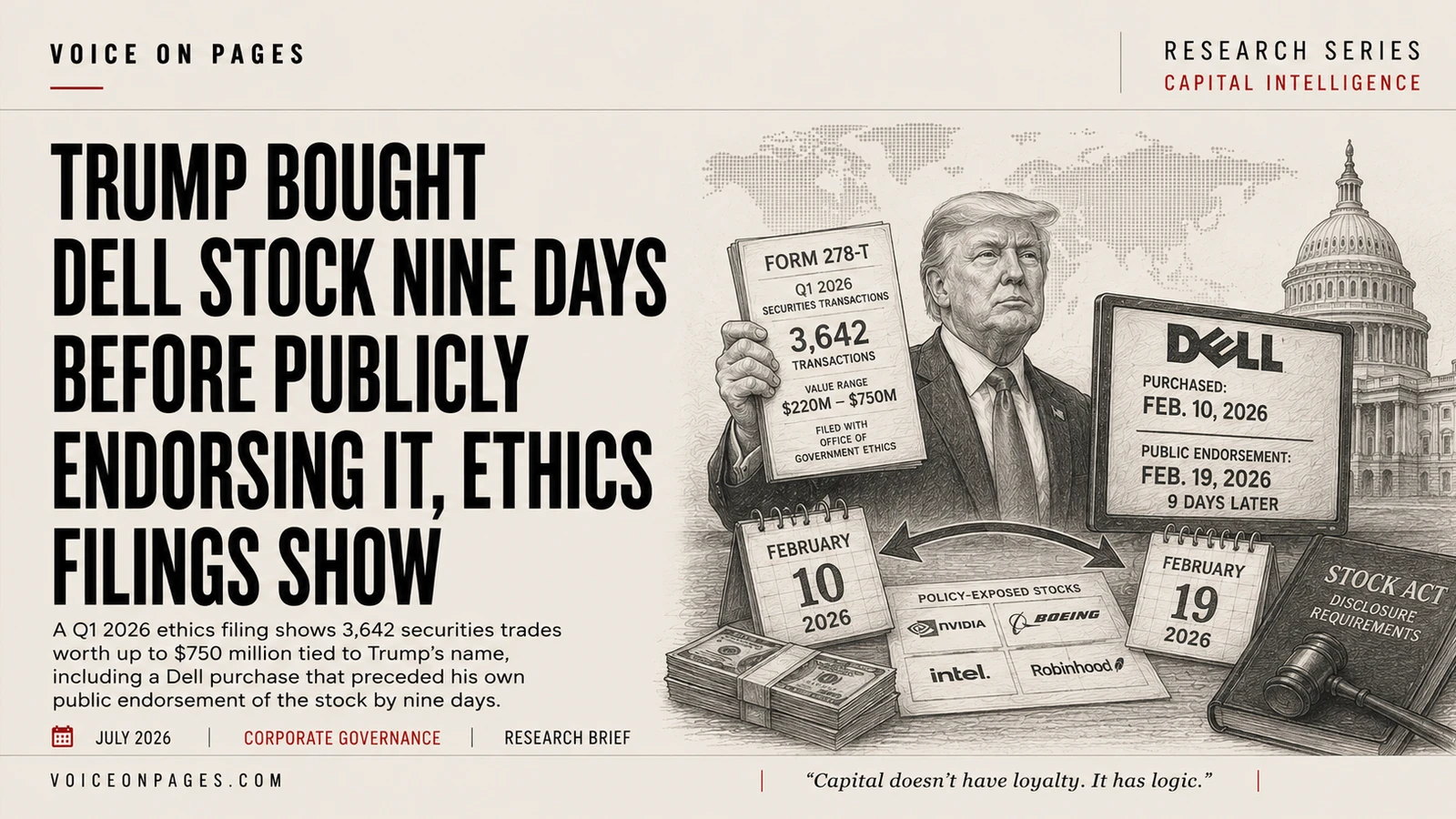
A first-quarter 2026 ethics filing discloses 3,642 securities trades tied to President Trump’s name, worth between $220 million and $750 million, and the documented timeline shows a Dell stock purchase on Feb. 10 followed nine days later by Trump’s own public endorsement of the company.
What Actually Happened
Two Form 278-T periodic transaction reports, together running more than 100 pages, were released by the Office of Government Ethics in May 2026, covering securities activity from the first three months of the year. An OGE search snippet confirms the total at 3,642 individual transactions. Because the STOCK Act requires filers to disclose transactions only in broad value bands rather than exact prices, the cumulative value spans a wide range, roughly $220 million to $750 million, and the filings do not specify exact profits, execution prices, or which broker or account placed each order.
One of the two reports carries an official late-fee notation. It was signed on May 8 and received by OGE on May 12, and under STOCK Act rules, transactions must be reported within 30 days of notification or 45 days of execution at the latest, meaning the filing itself documents that Trump missed the required window.
The purchases named in the filing include Microsoft, Meta Platforms, Oracle, Broadcom, Bank of America, and Goldman Sachs, along with municipal bonds. Individual large purchases in the $1 million to $5 million band included an S&P 500 index fund, Nvidia, and Apple. Large sales in the $5 million to $25 million band included Microsoft, Amazon, and Meta.
The Dell Timeline
The most specific, documented sequence in the filing involves Dell. On Feb. 10, 2026, an account in Trump’s name purchased between $1 million and $5 million in Dell shares. Nine days later, on Feb. 19, Trump publicly endorsed Dell. Additional, smaller Dell purchases followed in March, and the full sequence only became public in May 2026 when OGE released the periodic transaction reports, meaning the trades were not visible to the public until well after both the purchase and the endorsement had already happened.
The timing sits alongside other Dell-adjacent context: the company secured a $9.7 billion Pentagon contract in May 2026, and Dell director and Silver Lake co-CEO Egon Durban sold more than $27 million in Dell shares in June 2026. None of this establishes what motivated the February purchase or the endorsement that followed it. What the filing does establish, without interpretation, is the order of events: purchase first, public endorsement second, both a matter of public record only after a multi-month reporting delay.
The Broader Pattern: Policy-Adjacent Sectors
Dell was not the only Feb. 10 purchase in a policy-sensitive sector. The same date shows Nvidia and Boeing purchases, also in the $1 million to $5 million band, and the filing separately lists Intel among the quarter’s larger positions, alongside Palantir and Robinhood.
The timing around Nvidia and Boeing overlaps with a documented set of administration decisions. Trump administration officials invited Boeing CEO Kelly Ortberg and other business leaders to join the president’s China trip, with Nvidia CEO Jensen Huang later added to the delegation. Separately, Trump agreed to allow Nvidia H200 chip exports to China, a sale that had not yet proceeded as of the filing period because of pending licensing requirements. Robinhood’s presence in the filing is notable on separate grounds: the company was named to build and operate infrastructure for the administration’s new Trump Accounts savings program alongside BNY, serving as sole broker-dealer and initial trustee.
Taken together, the filing shows trading activity concentrated in semiconductors, aerospace, and financial infrastructure, sectors where federal policy decisions were being actively shaped during the same quarter. The filing itself does not identify who made each trading decision or through which account, a gap addressed in the next section.
The Annual Picture: $2.2 Billion in Income
Context for the Q1 trading activity arrived two months later. Trump’s 2025 annual financial disclosure, a separate 927-page filing released by OGE on July 1, 2026, reported approximately $2.2 billion in total income for the year. Roughly $1.4 billion of that came from cryptocurrency ventures, including more than $500 million through World Liberty Financial, a venture co-founded by Trump family members, and more than $600 million from sales of Trump-branded meme coins. NPR reported this as the largest personal crypto-income figure in presidential history.
The same annual filing disclosed non-crypto revenue: about $77 million from Mar-a-Lago, $122 million from the Doral golf club, more than $30 million each from courses in Bedminster, Jupiter, and Turnberry, plus millions more from licensing on Trump-branded watches, sneakers, fragrances, and other merchandise.
Compliance Gaps Documented in the Filings
Beyond the late-fee notation on the Q1 278-T, JURIST’s review of the annual filing found a broader pattern: every transaction listed on that particular form was flagged as reported more than the STOCK Act’s allowed window after the underlying trade, and the annual disclosure separately noted the accidental omission of licensing agreements for Trump-branded watches, sneakers, and fragrances in prior filings. Trump’s 2024 disclosure, by comparison, had listed its transactions section as “N/A.”
What Critics and Defenders Say
The Trump Organization’s position, echoed in broker notations within the filing itself marking trades “unsolicited” with “discretion exercised,” is that investment decisions are made independently by external brokerage firms through discretionary accounts, without Trump’s direct involvement, and that the president’s assets sit in a trust controlled by his children. The White House press office referred press questions on the Q1 filing to the Trump Organization.
Ethics watchdogs dispute that this structure removes the underlying conflict. CREW president Donald K. Sherman characterized the disclosures as consistent with an established pattern of the president making transactions in industries his own administration regulates. Former White House ethics lawyers Richard Painter, Norman Eisen, and Virginia Canter, who served administrations of both parties, argued in a joint opinion piece that a family-managed trust does not meet the bipartisan standard historically expected of presidents, namely divestiture or a genuine blind trust free of the president’s business network. Painter separately described the scale of Trump’s disclosed financial activity as a conflict of interest that would be a clear violation for any other executive branch official.
A separate, more sympathetic reading exists as well: supporters characterize the ethics criticism as a politically motivated response from Democratic-aligned watchdog groups, and note that Trump’s business dealings and family-managed trust structure were publicly known before his re-election. Legislative proposals to codify mandatory blind-trust requirements for presidents have stalled repeatedly in Congress across multiple administrations, and Trump is not subject to the primary federal conflict-of-interest statute that binds other executive branch officials, a distinction the administration has pointed to directly.
The Bottom Line
What the filings establish without dispute is sequence and scale: a Dell purchase nine days before a Dell endorsement, a cluster of policy-adjacent trades on a single February date, and a 2025 income total built substantially on a crypto industry the president’s own administration regulates. What the filings do not establish, because the disclosure format itself does not require it, is who made each trading decision or why. That gap is exactly where the dispute between watchdogs and the administration lives, and it is unlikely to close through disclosure alone. Because in the end, capital doesn’t have loyalty. It has logic, and right now that logic is legally permitted to sit inside a trust the public can see into only months after the fact.
Sources: U.S. Office of Government Ethics filings, Reuters, NBC News, TradingView/Invezz, JURIST, NPR, CREW (Citizens for Responsibility and Ethics in Washington), verified via Perplexity and web search, July 2026.